.png)


How Much Does DoorDash Charge Restaurants? The Real Cost Behind Every Order
If you have ever wondered how much does DoorDash charge restaurants, you are not alone. Thousands of restaurant owners sign up for DoorDash expecting a simple delivery partnership and discover months later that the fees are quietly eating into their margins. DoorDash charges restaurants between 15 and 30 percent commission on every order, depending on the plan tier. When you add payment processing fees, marketing boosts, and promotional costs on top of that, the true cost of each order can climb well above what most owners initially expect.
This guide breaks down every fee DoorDash charges, explains what each tier actually includes, and walks through a smarter strategy that the most profitable restaurants are using in 2026 to increase restaurant sales without giving up a third of their revenue.
How DoorDash Pricing Works: Three Plans and What They Actually Cost
DoorDash uses a tiered commission model that gives restaurants three marketplace pricing plans to choose from. Each plan comes with a different commission rate, a different level of marketing exposure, and a different set of tradeoffs for your business. Understanding how these doordash restaurant fees change by tier is the first step toward deciding whether the platform makes financial sense for your operation and which option delivers the best return.
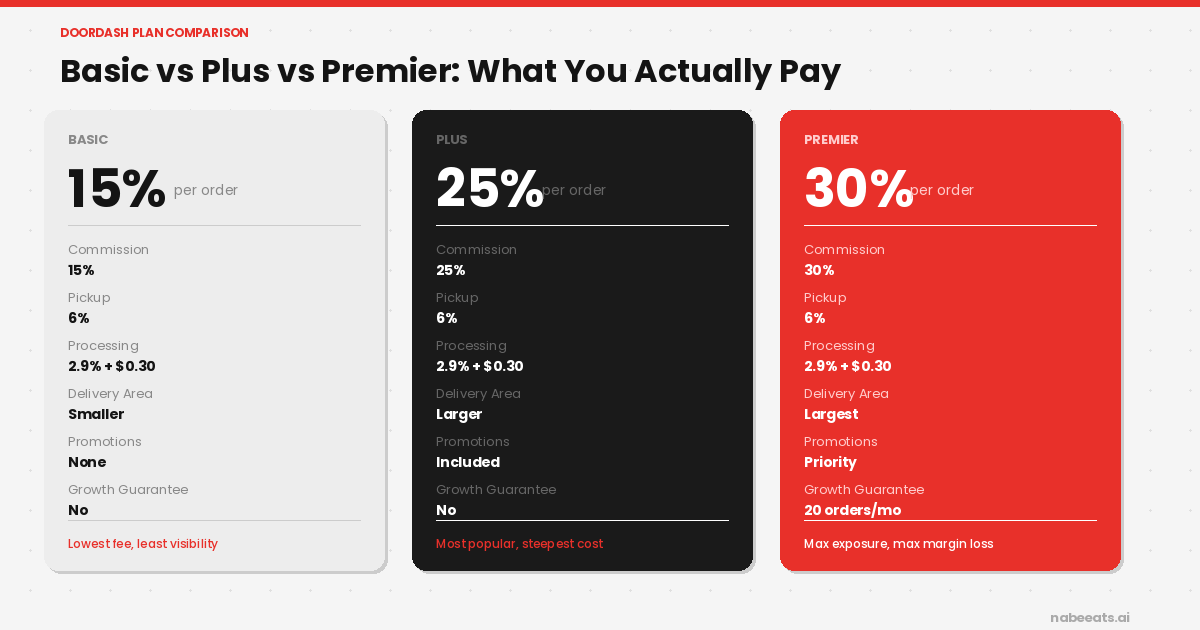
The Basic Plan charges a 15 percent commission on each delivery order. This is the lowest doordash restaurant fee you can pay for delivery orders, but it also comes with the least visibility inside the DoorDash app. Your restaurant will not appear in DashPass searches, which limits access to the most frequent and highest spending customers. Pickup orders on this plan carry a 6 percent commission, which is often overlooked when restaurants calculate total doordash restaurant fees.
The Plus Plan charges a 25 percent commission per delivery order. This doordash restaurant fee includes DashPass eligibility, giving your restaurant exposure to subscribers who order more often and typically spend more per order. You also get a wider delivery radius compared to the Basic tier, which increases reach without changing your menu or pricing. Pickup orders remain at 6 percent, making this plan a common middle ground for restaurants balancing visibility and cost.
The Premier Plan charges a 30 percent commission on every delivery order. This is the highest doordash restaurant fees tier and includes all Plus features, automatic advertising at no extra cost, broader search placement, and a growth guarantee that refunds your monthly commission if you receive fewer than 20 orders. While the guarantee sounds compelling, most active restaurants exceed that threshold quickly, meaning the full doordash restaurant fee almost always applies.
Commissions are not the only costs restaurants face when using DoorDash. All plans include payment processing fees of 2.9 percent plus 30 cents per transaction for DoorDash Online Ordering. Additional costs may apply for tablet rentals after the initial trial period, sponsored listings that boost placement in search results, and promotional discounts you choose to run. These extras can quietly raise your effective doordash restaurant fee and significantly increase your total spend over the course of a year.
How Much Does DoorDash Actually Take From a Typical Order?
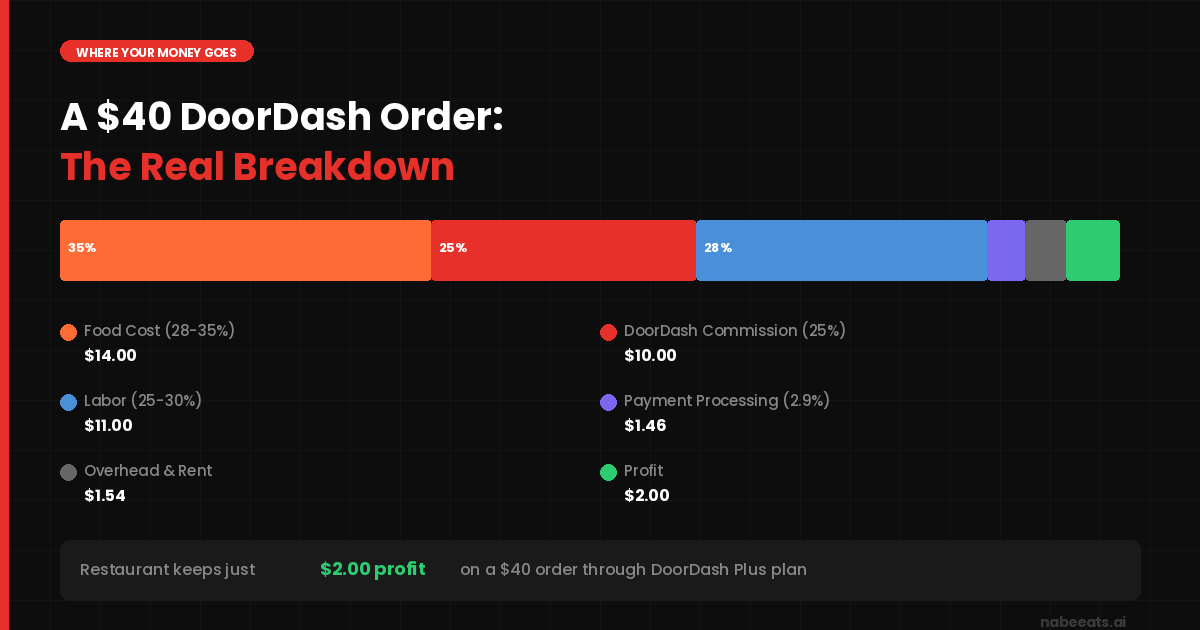
The commission percentages look manageable on paper. The reality hits differently when you run the numbers on an actual order.
Consider a $40 delivery order on the Plus Plan at 25 percent commission. DoorDash takes $10 from that order immediately. If the food cost percentage for the restaurant on that order is 30 percent, that is another $12 going to ingredients. Labor, rent, utilities, and overhead typically consume another 30 to 35 percent of revenue. On a $40 order, that leaves the restaurant with somewhere between $2 and $4 in actual profit, and that is before any promotional discounts, marketing spend, or packaging costs are factored in.
Now multiply that across 20 or 30 orders per day. A restaurant doing $1,200 in daily DoorDash revenue on the Plus Plan is sending $300 per day to DoorDash in commissions alone. That is $9,000 per month, or $108,000 per year, going to a single platform just for the privilege of receiving orders. For context, $108,000 per year is enough to hire two full-time employees, invest in kitchen equipment, or fund an entire year of direct marketing that builds an audience you actually own.
Many restaurant owners try to offset these costs by raising menu prices on DoorDash by 10 to 20 percent. This helps protect margins on individual orders, but it also makes your food look more expensive compared to competitors on the same platform. When customers are browsing DoorDash and comparing prices side by side, even a small price difference can push them toward a competitor. It is a difficult balancing act with no perfect solution as long as the commission structure stays the same.
When restaurant owners ask how much does DoorDash charge restaurants with premium menus, the numbers become even more challenging. A sushi restaurant or steakhouse with a 35 to 40 percent food cost operating on the Premier Plan at 30 percent commission has almost no margin left on delivery orders. At that point, DoorDash orders are essentially a marketing expense rather than a revenue source.
Why Relying on DoorDash Alone Puts Your Restaurant at Risk
DoorDash can feel like a lifesaver when you first sign up. Orders start coming in. New customers discover your restaurant. Delivery logistics disappear from your to-do list. For many restaurants, it is the easiest way to grow off-premise revenue fast. There is a reason so many restaurants use it: a built-in customer base, instant exposure in your area, and access to DashPass users who order frequently.
But here is the question most owners do not ask soon enough: what happens when DoorDash becomes your only ordering channel?
Three things happen gradually, and none of them are good for your long-term profitability.
First, you lose ownership of the customer relationship. DoorDash controls the customer data. You do not get the email address. You cannot send a follow-up promotion. You cannot build your own database of repeat customers. The platform owns the relationship, and you are renting access to it with every commission payment. When a customer orders from you through DoorDash, they think of it as a DoorDash order, not as ordering from your restaurant. That distinction matters when it comes to building brand loyalty and repeat business.
Second, you compete inside their marketplace against every similar restaurant in your area. Your listing sits next to five other restaurants offering the same cuisine, many of them running discounts and promotions to win the click. You are no longer competing on your brand, your food quality, or your reputation. You are competing on placement, price, and promotional spend inside an ecosystem controlled by another company. The restaurants that win in this environment are often the ones willing to spend the most on marketing within the app, which further erodes margins.
Third, your revenue becomes dependent on their algorithm. If your visibility drops because a competitor outspends you on promotions, your orders drop. If DoorDash changes its fee structure or introduces new charges, your margins shift overnight. If new policies roll out regarding delivery zones, menu pricing, or promotional requirements, you adapt on their timeline, not yours. That is a significant amount of dependency on a single revenue stream that you do not control.
Restaurants that rely on a single third-party platform often experience margin compression, rising promotional costs, reduced pricing flexibility, and less predictable revenue month over month. Diversification is not just a growth strategy. It is a survival strategy for any restaurant that wants to improve restaurant sales sustainability over the long term.
How the Most Profitable Restaurants Use DoorDash in 2026
The smartest restaurant operators do not abandon DoorDash. They use it strategically as one piece of a larger system designed to boost restaurant sales across multiple channels while protecting their margins on the orders that matter most.
Think of DoorDash as a customer acquisition tool, not your entire delivery business. The platform excels at putting your restaurant in front of people who have never heard of you before. It is powerful for discovery. But discovery should be the beginning of a customer relationship, not the entire relationship.
Start by using DoorDash for what it does best: getting discovered by new customers. Let it introduce your restaurant to people in your area who have never ordered from you before. The massive DoorDash user base and search functionality make it excellent for this specific purpose, and the commission you pay on those first orders is essentially a customer acquisition cost.
Then build a bridge to direct ordering. Include a printed insert in every DoorDash delivery bag that offers a first-time discount for ordering through your own website. Set up a loyalty program on your own restaurant online ordering platform that rewards customers for coming back directly. Offer exclusive menu items or slightly better pricing for direct orders. Create a simple landing page that makes it easy for customers to find your direct ordering link. These small incentives add up quickly and create a natural migration path from third-party to first-party ordering.
You are not fighting DoorDash when you do this. You are building your own ecosystem alongside it. The platform handles discovery and one-time orders. Your own ordering system handles retention, repeat business, and margin protection.
Even shifting 20 to 30 percent of your delivery volume from DoorDash to direct ordering can dramatically change your profitability. On those orders, you keep the full margin. You own the customer data. You can run your own promotions and build the kind of long-term loyalty that no third-party app can replicate. Over time, as more customers make the switch, the percentage of your revenue going to commissions decreases while your total revenue continues to grow.
Why Having Your Own Online Ordering Platform Changes Everything
When customers order directly through your own restaurant with online ordering built into your website, the economics shift in your favor immediately. You keep more of every dollar. You collect customer names, emails, phone numbers, and order history. You can send targeted promotions based on what they have ordered before. You can run seasonal campaigns, birthday offers, and reactivation emails for customers who have not ordered in a while. You build real relationships instead of renting access to an audience owned by someone else.
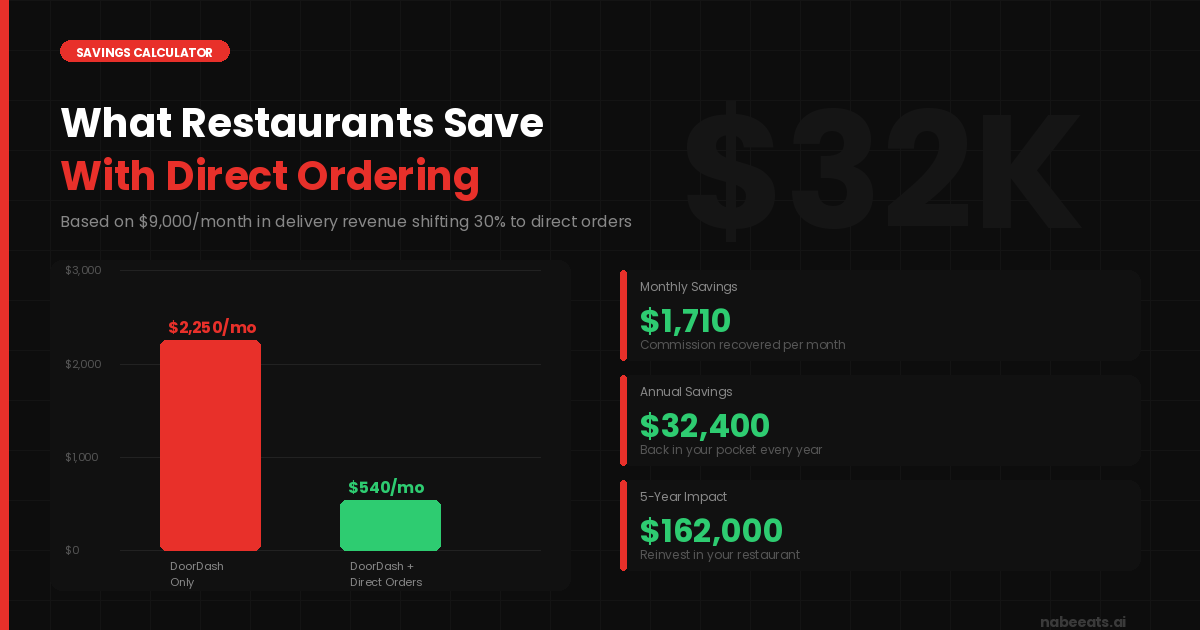
A restaurant running $1,200 per day in delivery revenue through DoorDash on the Plus Plan pays roughly $9,000 per month in commissions. If that same restaurant shifts just 30 percent of that volume to a direct ordering system with zero commissions, that is $2,700 per month back in their pocket. Over a year, that is $32,400 in recovered margin. That money can fund better ingredients, staff bonuses, kitchen upgrades, or marketing campaigns that drive even more direct orders. The compounding effect is significant.
The balanced strategy that wins in 2026 looks like this: DoorDash handles discovery and incremental reach for new customers. Your own online ordering system handles repeat customers and margin-protected revenue. Email or SMS marketing tied to direct orders keeps customers engaged between visits and brings them back before they default to opening the DoorDash app. A loyalty program rewards customers for ordering from you instead of through a third-party platform, creating a financial incentive that compounds over time.
You stop being just a listing in an app. You become a brand that customers seek out on their own.
Platforms like Nabe Eats are built specifically for this approach, giving independent restaurants a zero-commission ordering system paired with AI-powered marketing tools that automate the customer retention side of the equation. The goal is not to replace DoorDash entirely. It is to make sure no single platform controls your future, your margins, or your customer relationships.
The restaurants that thrive in 2026 are not choosing between third-party platforms and direct ordering. They are building systems that use both strategically, keeping DoorDash for what it does best while owning the channels that drive the most profitable, repeatable growth.
Frequently Asked Questions
How much does DoorDash charge restaurants per order?
DoorDash charges restaurants between 15 and 30 percent commission per delivery order depending on the plan. The Basic Plan costs 15 percent, the Plus Plan costs 25 percent, and the Premier Plan costs 30 percent. All plans also charge a 6 percent commission on pickup orders placed through the app, plus payment processing fees of 2.9 percent plus 30 cents per transaction.
Is DoorDash profitable for restaurants?
DoorDash can generate incremental revenue, but profitability depends heavily on your food costs, menu pricing strategy, and how much volume you process through the platform. Many restaurants find that after accounting for commissions, food costs, labor, and overhead, the profit margin on DoorDash orders is significantly lower than on direct or in-house orders. Restaurants with food costs above 35 percent often break even or lose money on DoorDash delivery orders.
How can restaurants reduce DoorDash fees?
The most effective strategy is to use DoorDash for customer acquisition while building your own direct ordering channel for repeat business. Including inserts in delivery bags, offering loyalty rewards for direct orders, and promoting your own website for ordering all help shift volume to commission-free channels over time. Some high-volume restaurants also negotiate custom commission rates directly with DoorDash, though this option is typically only available to larger operations.
What is the best alternative to DoorDash for restaurants?
The best alternative is not a different third-party app with similar fees. It is building your own restaurant online ordering platform that lets you accept orders directly through your website with zero commissions. This gives you full control over customer data, pricing, promotions, and the overall ordering experience while keeping 100 percent of your revenue.
Should restaurants stop using DoorDash completely?
No. DoorDash is a powerful discovery tool that can introduce your restaurant to new customers who might never find you otherwise. The key is to avoid relying on it as your only ordering channel. The most successful restaurants in 2026 use a balanced approach: third-party platforms for exposure and their own ordering system for repeat business and margin protection.
How much can restaurants save by switching to direct online ordering?
A restaurant processing $1,200 per day through DoorDash on the Plus Plan pays approximately $9,000 per month in commissions. Shifting just 30 percent of that volume to a zero-commission direct ordering platform saves roughly $2,700 per month, or over $32,000 per year in recovered margin. As more customers migrate to direct ordering, the savings increase proportionally.
.png)


.png)


