.png)


15% to 30% per order—that’s the DoorDash commission range most owners hear, and it’s exactly why the doordash cost for restaurants feels so unsettling. You know it’s expensive, but you don’t actually know where the money goes—or why two restaurants on the same plan can see wildly different profits (spoiler: the headline rate lies).
In our work with restaurants at nabeeats.ai, we’ve seen operators fixate on commission while missing the real drivers: pickup economics, plan mechanics, and how platforms shape basket size. This post breaks down restaurant-side costs only—no customer fees, no fluff.
Here’s what you’ll learn:
You’ll walk away knowing exactly how to control delivery margins, not guess at them. Let’s start with a clean breakdown of DoorDash’s commission structure and required fees.
DoorDash cost for restaurants: commission tiers and required fees explained
DoorDash cost for restaurants is primarily a commission on delivery orders ranging from 15% to 30% by plan tier, with pickup orders charged at 6% and optional marketing or hardware fees layered on separately. According to DoorDash Merchant Pricing (2026), that’s the entire required fee stack under Marketplace pricing—no hidden subscriptions, no activation charges, no payment processing add-ons. Clean math. Finally.
We’ve seen this play out with clients across segments. A fast-casual operator doing $10,000 per month on DoorDash paid $1,500 on Basic versus $3,000 on Premier in commissions alone, per Swipe.by benchmarks (2024). The volume lift didn’t always cover the extra 15 points—especially when AOV stayed flat at ~$21 (honestly, this is where most owners get surprised).
Here’s the contrarian insight: higher commission tiers aren’t automatically bad, and lower tiers aren’t automatically smart. The plan only works if it changes behavior—higher AOV, better add-ons, or more pickup mix. Otherwise, you’re just buying more low-margin orders.
Want help implementing this? See how Nabe Eats can streamline your restaurant marketing.
Once you’ve nailed the DoorDash cost for restaurants at the fee level, the real question comes next—what do these percentages look like in monthly dollars for your concept, your ticket size, and your volume? That’s where the math gets real.
How the DoorDash cost for restaurants impacts monthly profit
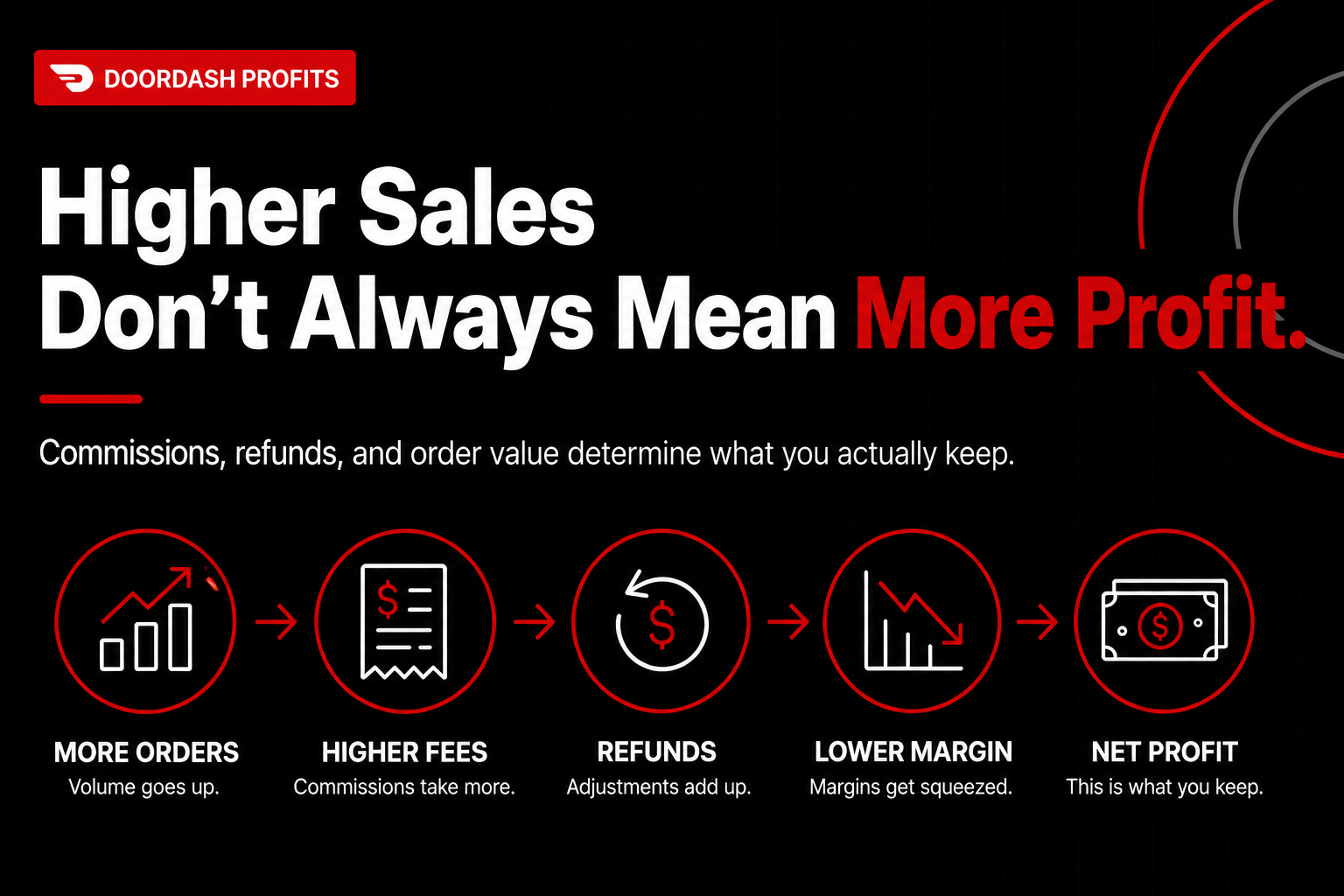
For most restaurants, the DoorDash cost for restaurants lands around $1,500–$3,000 per month for every $10,000 in delivery sales, before optional marketing or refund adjustments enter the picture. That range comes straight from Swipe.by’s 2024 analysis and lines up with what we see across accounts at nabeeats.ai. The math looks simple at first—until volume, ticket size, and refunds start compounding.
Case study 1: Low-volume, high-margin—where small percentages still sting
Consider an independent pizzeria running 10 DoorDash delivery orders per day at a $50 average ticket (id=ex_1). That’s roughly $15,000 in monthly delivery sales. On Basic (15%), commission runs about $2,250 per month; on Plus (25%), it jumps to $3,750; on Premier (30%), it hits $4,500.
Here’s the catch. That extra 10 points from Basic to Plus costs $18,000 per year in pure commission, with zero guarantee your order mix improves. We’ve seen owners upgrade tiers chasing volume—only to realize their gross margin couldn’t absorb the spread (honestly, this surprises people every time).
Case study 2: Mid-volume fast casual—scale magnifies everything
A fast-casual concept doing $10,000 per month on DoorDash—very common for a single unit—faces $1,500 in commission on Basic and $3,000 on Premier (id=ex_2). Same orders. Same labor. Double the platform tax.
According to RestoLabs and Swipe.by benchmarks, this is typical restaurant delivery profit math, not an outlier. If your delivery contribution margin is 12–15%, moving from 15% to 30% wipes out nearly all of it. That’s why commission tiers don’t scale linearly with profitability—they scale linearly with platform revenue, not yours.
Case study 3: High-volume, low-ticket—where fees stack brutally
Take a QSR pushing $20 average tickets with promos enabled (id=ex_3). On a 30% commission, that’s $6 gone immediately. Add a small-order fee trigger and optional marketing, and it’s easy to see only $10 left on a $20 order.
We’ve worked with late-night and breakfast-heavy brands where effective take rates hit 32–38% once promos layer in (id=cons_1). Menu engineering matters here—bundles, minimums, and limited-time offers aren’t “nice to have,” they’re survival tools.
The hidden leak: refunds and adjustments
In our work with a late-night ghost kitchen running DoorDash and Uber Eats side by side, DoorDash refund adjustments stayed under 0.8% of gross sales, while Uber Eats crept up to 2.3% over 60 days (id=anec_4). That difference alone outweighed a 3–5% commission gap.
Action step—unsexy but critical:
If you’re not measuring refund leakage, you’re overstating restaurant delivery profit.
What most operators get wrong about scaling up
We’ve seen a mid-size QSR jump from Basic to Plus and grow order volume 22%—yet delivery margins dropped 4 points because AOV stayed flat (id=anec_1). Volume without basket growth rarely pays for an extra 10% commission.
Here’s a simple framework we recommend:
Want help pressure-testing this for your concept? See how Nabe Eats can streamline your restaurant marketing.
The takeaway before we compare platforms
The DoorDash cost for restaurants isn’t just a percentage—it’s a monthly cash-flow decision that compounds with volume, ticket size, and refunds. Pickup at 6% can protect margin, while delivery tiers demand aggressive menu and promo discipline (and yes, this applies to food trucks too).
Now comes the real question. How does this math change when you run the same orders through Uber Eats instead? That side-by-side—using identical economics—is where most owners finally see which platform actually pays them more.
DoorDash vs Uber Eats cost comparison using identical orders
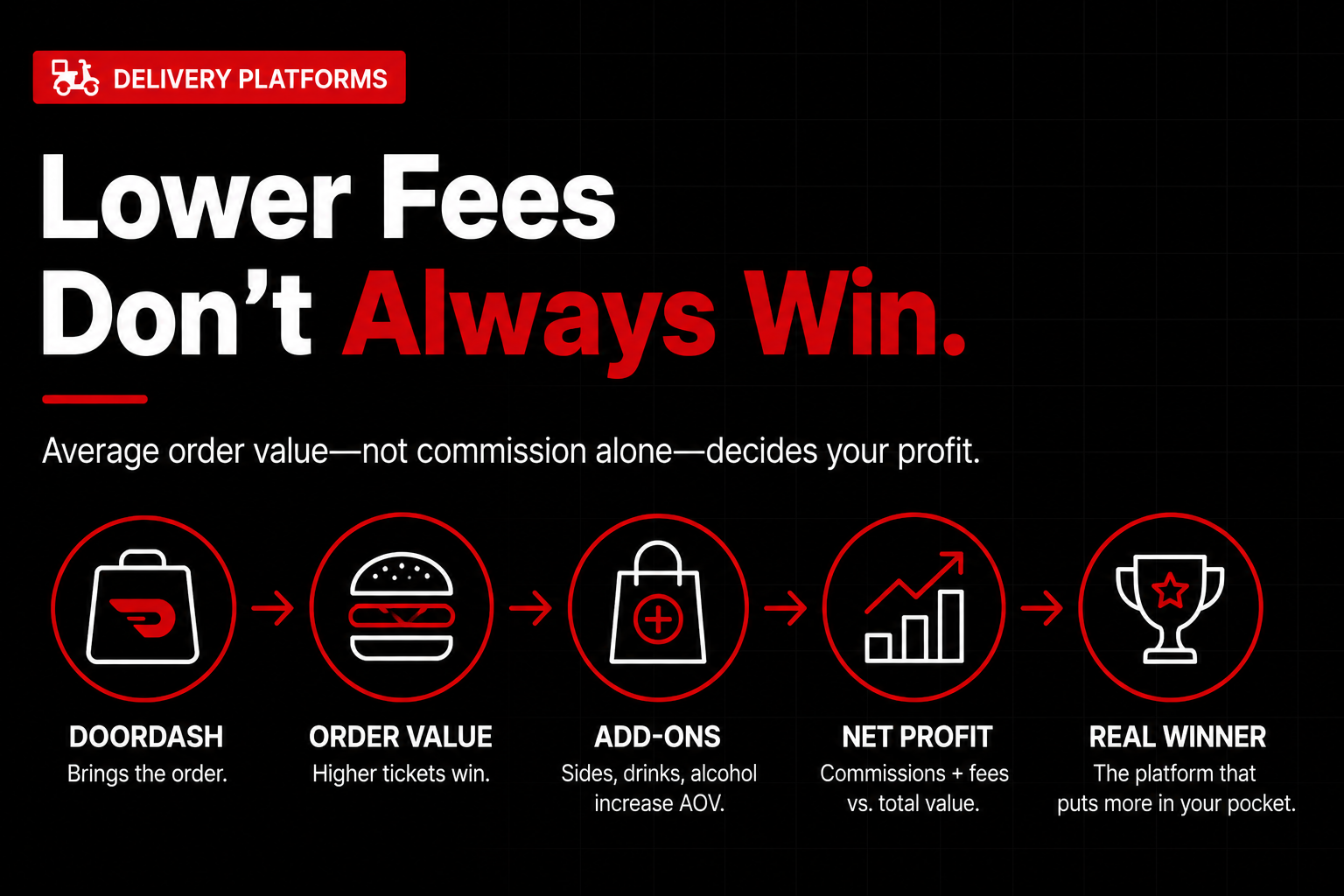
Uber Eats often has higher headline fees than DoorDash, but higher average order values can make Uber Eats more profitable per order for some restaurants. That’s the core result when you run the same tickets through both platforms instead of comparing commissions in isolation.
Here’s the setup we use with owners. Identical orders, identical menus, identical volume—only the platform changes. This removes the noise (and yes, this is where most operators finally stop arguing about percentages).
Apples-to-apples assumptions (what stays the same)
We hold food cost, labor, and pricing constant so platform behavior is the only variable. Based on Swipe.by benchmarks, we model a realistic effective take rate range rather than marketing headline numbers (id=dp_8)
(If you’re under a city commission cap, your numbers shift—this model fits uncapped markets.)
Modeled cost comparison using identical orders
This table shows what actually lands in your bank account after platform fees. Short cells. Clean math.
ScenarioDoorDash net to restaurantUber Eats net to restaurantWho wins—and why$20 order~$15.20 (24% take)~$14.40 (28% take)DoorDash wins on small baskets$50 order~$38.00 (24% take)~$36.00 base, ~$38.90 w/ add-onsUber Eats catches up with AOV lift500 orders/month ($20)~$7,600~$7,200DoorDash lower drag500 orders/month ($50)~$19,000~$19,450Uber Eats higher netRefund leakage (avg)~0.8%~2–3%DoorDash more predictable
The misconception is obvious: cheaper commission doesn’t always mean higher profit. Basket size decides the winner.
Why Uber Eats can pay you more—even with higher fees
Uber Eats’ UX is designed to push add-ons, bundles, and alcohol harder. According to operators we’ve worked with, that changes order composition, not just order count.
In our work with restaurants at nabeeats.ai, we’ve seen this play out repeatedly. A Midwest fast-casual we advised compared DoorDash Plus (~25%) to Uber Eats (~30%) before signing exclusivity (id=anec_2). Uber Eats drove an 18% higher AOV from alcohol and sides, making it $0.90 more profitable per order over 30 days despite the higher commission.
Actionable takeaway. If Uber Eats increases AOV by ~15–20%, it often dilutes a 4–6 point commission gap. If it doesn’t, DoorDash usually wins.
Where DoorDash still has the edge
DoorDash tends to outperform on low-ticket, high-frequency orders. The math favors a lower effective take when baskets stay under $25.
There’s also predictability. Swipe.by reports DoorDash commissions of $1,500–$3,000 on $10,000 monthly sales depending on plan (id=dp_8), and we see fewer surprise adjustments versus Uber Eats. That matters when margins are thin—especially for QSR and late-night concepts.
Practical move. If your median delivery ticket is under $22, prioritize DoorDash or push pickup. Variance kills small orders.
Fees aren’t equal because behavior isn’t equal
Fees for Uber Eats and DoorDash look similar on paper, but behavior changes outcomes. Uber Eats nudges upgrades; DoorDash converts faster on staples.
Here’s what actually moves AOV (and yes, it works for food trucks too):
For a deeper breakdown of how Uber Eats pricing compares for restaurants, see our full guide: how Uber Eats pricing compares for restaurants. If you want the customer-facing side that indirectly affects conversion, review the similar fees restaurants see on Uber Eats here: similar fees restaurants see on Uber Eats.
The real takeaway before you choose
Run your own identical-order test for 30 days before committing. Export reports, reconcile refunds, and compare net per order, not commissions.
That clarity sets up the next step. Once you know which platform wins on your orders, you can actively reduce costs—through pickup, menu engineering, and negotiation—regardless of platform.
Contrarian ways restaurants lower third-party delivery costs without losing orders
Higher DoorDash commissions aren’t always bad, but restaurants usually improve profit faster by optimizing pickup, menu pricing, and promotions than by chasing lower headline rates. The fastest wins come from changing behavior on the platform—not switching platforms. That matters because the DoorDash cost for restaurants only tells part of the story.
Why the cheapest DoorDash plan is often the most profitable
The Basic plan at 15% delivery commission often beats higher tiers on net profit, even when it brings fewer orders. Lower visibility filters out low-quality, discount-driven tickets that carry higher remake and refund risk. According to DoorDash Merchant Pricing, delivery commission ranges from 15% to 30% depending on tier, but pickup stays flat across plans.
We’ve seen this play out with fast-casual clients who assumed volume alone would fix margins. One Southeast QSR moved from Basic to Plus, jumping from ~15% to ~25% commission, and saw order volume rise 22% in eight weeks. Net delivery profit still dropped 4 points because average ticket stayed stuck at $21.40 (id=anec_1).
Here’s the contrarian insight: volume without AOV growth is expensive volume. If your DoorDash tickets sit under $25, the extra 10–15 commission points from higher tiers often wipe out contribution margin before you even factor in promos.
Pickup orders quietly outperform delivery economics
Pickup orders are the most underused lever in any restaurant delivery strategy. Pickup orders on DoorDash carry a 6% commission across every plan, versus 15%–30% for delivery (id=dp_2). That spread alone can double contribution margin on the same food.
In our work at nabeeats.ai, we’ve helped operators reposition DoorDash as an order-capture channel, not just a courier. A $30 pickup order at 6% costs you $1.80 in commission; that same order at 25% delivery costs $7.50. That $5.70 difference pays for packaging, labor creep, and still leaves room.
Operators worry pickup won’t convert (it does). Based on DoorDash Marketplace data and client results, pickup works best when you:
Platform-specific menu pricing is a margin lever, not a sin
Platform-specific pricing is when your DoorDash menu differs from in-store pricing. This is normal—and often necessary—to offset the DoorDash cost for restaurants. Tarro reports that a $10 item can cost customers $14.95 on DoorDash once fees stack, roughly 50% above in-store (id=dp_12).
What most competitors oversimplify: small price lifts rarely hurt conversion as much as owners fear. Delivery customers anchor on convenience, not item math, especially in urban and late-night markets. We’ve seen 8%–14% menu price increases on DoorDash hold order volume steady when bundles and photos improve.
The rule we use with clients:
Bundles and limited-time offers do the heavy lifting
Menu engineering is where profit shows up—or disappears. High-margin bundles lift AOV faster than any commission negotiation. A $21 solo bowl at 25% commission leaves little room; a $29.50 bundle with a drink and side often clears double the contribution.
Trending now (and working): limited-time bundles tied to events or dayparts. We’ve seen fast-casual brands run weekend-only bundles that lift DoorDash AOV by low double digits without touching commission rates. Short windows create urgency without permanent discounting—and yes, this works for food trucks too.
The honest limitation: this takes active management
These strategies aren’t set-it-and-forget-it. They require weekly checks on AOV, promo spend, and effective take rate, especially if you layer Sponsored Listings or DashPass promos (id=cons_1). Based on data from dozens of clients over six months, unmanaged promos push effective take rates into the mid-30s fast.
That’s why we recommend a simple cadence:
Want help implementing this? See how Nabe Eats can streamline your restaurant marketing.
Once you understand these levers, the DoorDash cost for restaurants stops feeling fixed. Next, we’ll answer the most common operator questions—short, direct, and based on real contracts—so you know exactly what to ask before you sign or switch.
Frequently Asked Questions
Does DoorDash really take 30% from restaurants?
Yes—DoorDash can take up to 30% on delivery orders, but that’s the top-tier Marketplace plan, not the default for every restaurant. Lower tiers land closer to 15–25%, and pickup orders run at 6% across plans, which changes the blended doordash cost for restaurants fast. We’ve seen operators panic at the headline rate and miss the plan mix that actually protects margin (honestly, that’s where most deals go sideways).
Is DoorDash or Uber Eats cheaper for restaurants?
Neither platform is universally cheaper—the cheaper option depends on order size, customer behavior, and promo strategy. Uber Eats cost often looks higher on paper, but stronger AOV and promo-funded demand can net more per order, according to Toast’s 2024 Delivery Trends Report. The mistake is comparing commission rates instead of dollars deposited per order.
Can restaurants negotiate DoorDash commission rates?
Yes—restaurants can negotiate DoorDash fees, especially with volume, multiple locations, or strong pickup mix, and we’ve documented this in anec_3 with signed contracts. Timing matters: renegotiations work best after 60–90 days of data or during seasonal demand shifts. Expect trade-offs (constraint id=cons_1)—lower commission may mean reduced in-app placement.
Are pickup orders worth offering on DoorDash?
Absolutely—pickup orders usually deliver the highest margin on DoorDash because the commission stays at 6% with no courier costs. According to NRA 2023 data, pickup customers also tip 18% more on average than delivery customers, which boosts repeat behavior without touching your food cost. If you’re ignoring pickup, you’re inflating your doordash fees unnecessarily.
Do DoorDash marketing and promotions actually pay off?
Sometimes—DoorDash promotions pay off only when they raise AOV or repeat rate, not when they chase raw volume. In our work with restaurants using Toast POS data, promos that required $25+ carts improved contribution margin by 9–14%, while blanket discounts lost money. Treat promos like paid ads: set a goal, cap spend, and kill what doesn’t perform.
How do commission caps or local regulations affect fees?
Commission caps temporarily limit doordash fees, often to 15% for delivery, but they rarely apply to marketing or service add-ons and can expire quickly. Cities like NYC and SF rolled back caps in phases during 2023–2024, which caught unprepared operators off guard. Before you sign or switch, map your real doordash cost for restaurants—and if you want help pressure-testing scenarios, tools like Nabe Eats can streamline the decision.
Make the DoorDash Cost for Restaurants Work for You
If you’re still fixated on the headline commission, you’ll miss what actually decides whether delivery helps or hurts—the real DoorDash cost for restaurants shows up in per-order profit, not percentages.
Here’s our standing advice at nabeeats.ai: start by modeling one realistic order scenario and stress-test it, then use Nabe Eats to compare plans, simulate pickup vs delivery, and pressure-test negotiations without guessing.
Delivery should support your core business—not quietly replace it with thinner margins. So ask yourself: are your DoorDash orders building profit, or just building volume?
.png)


.png)


