.png)


6.11%. That’s the average online conversion rate for food and beverage—more than double general ecommerce—and yet most restaurants still treat website ordering like a traffic problem instead of a conversion one. We’ve seen operators pour 30–40% more spend into ads while orders barely move (spoiler: the leak is usually on-page).
Here’s the uncomfortable truth: most restaurants already have enough website visitors to grow orders, but friction inside the ordering flow quietly kills intent. According to Redstag Fulfillment’s 2026 benchmarks, food & beverage outperforms every other category—when the mechanics work.
In this breakdown, our team at nabeeats.ai gets practical. No platform pitches. No design fluff. Just how website ordering actually functions behind the scenes—and where UX and operational decisions suppress or unlock demand.
You’ll learn:
First, you need to understand what website ordering really is—and how the system works before you try to optimize it.
What website ordering is and how it works for restaurants
Website ordering is a restaurant’s direct online sales channel that lets guests place pickup or delivery orders through the restaurant’s own website, fully integrated with menus, payments, and kitchen operations. This is not a marketplace app—it’s the ordering experience you control, branded as your restaurant ordering website, and tied directly to how your operation actually runs. When someone searches for a website for my restaurant, this is the system they’re expecting to use, whether you’re launching a website for restaurant online ordering for the first time or migrating away from third-party apps.
That distinction matters more than most operators realize. Marketplace apps optimize for their conversion, not yours, which is why design decisions often prioritize upsells or ads over speed and clarity. On your own website ordering flow, every click either builds confidence or leaks it (and yes, guests notice). We’ve seen this play out with clients who assumed “online ordering is online ordering,” only to discover a consistent 7–11% gap in completion rates between marketplace traffic and their own site based on updated 2026 performance data.
Website ordering is an embedded system, not a page
Website ordering is the ordering engine embedded inside your site, not a standalone microsite or third-party redirect. Guests never feel like they’re leaving your brand, which reduces hesitation at checkout and improves trust signals like pricing consistency and item availability. According to 2026–2027 Digital Applied benchmarks, the gap between median (around 2.8%) and top-decile (11%+) website conversion rates continues to widen—control and optimization explain most of that spread.
From a technical standpoint, your restaurant ordering website runs on structured rules, not just visuals. It usually sits on top of tools like Toast Online Ordering, Square Online, or Olo, then connects back to your POS. This is the same foundation operators use when rolling out a website for restaurant online ordering across new locations, with the guest seeing a menu while the system processes modifiers, prep times, and throttles behind the scenes.
The online menu is the foundation of website ordering
An online menu for restaurants is not just a digital version of your printed menu; it’s the backbone of the entire website ordering experience. Category structure, item naming, and default modifier logic directly affect how fast guests move from browse to checkout. When menus are scannable and predictable, ordering feels effortless, especially on mobile.
A well-structured online menu for restaurants also drives revenue. Clear upsell placement, smart modifier defaults, and limits on unnecessary choices increase average order value without slowing guests down. From an SEO standpoint, clean menu URLs and consistent item naming improve visibility for branded and “near me” searches, feeding more qualified traffic into your website ordering funnel.
The core components that actually drive completion
Every website ordering flow relies on the same six building blocks, regardless of platform. If one breaks, conversion drops—even if the others look fine. Here’s what you should audit first:
Menu complexity alone can quietly erode conversion. In our work at nabeeats.ai, we’ve seen unnecessary modifier stacking cost 3–5% in completion rates. One fast-casual client cut two low-usage modifier sets—each under a 1% selection rate—and saw fewer order errors and faster checkout within a week.
Why speed, sync, and simplicity matter more than design
Latency kills confidence faster than bad branding. Updated Google and Deloitte research shows a 0.1-second improvement in mobile load time can lift conversions by 6–8%, and sites loading in under one second convert roughly three times higher than those at five seconds. On a restaurant ordering website, delays usually come from heavy menu assets, bloated online menus, or slow POS sync—not your homepage visuals.
Sync issues create distrust that lingers beyond a single order. When guests see items available online that the kitchen can’t fulfill, they abandon future orders, not just the current one. We’ve watched operators spend 4–6 hours a week fixing hours, prices, or 86’d items manually, time that should go toward optimization. Centralized menu governance solves most of this, especially for multi-unit groups operating a shared website for restaurant online ordering.
Time promises are conversion levers (not just operations settings)
Pickup and delivery times actively shape demand. Overly conservative time slots can suppress checkout completion by 7–12%, based on current operational benchmarks across our client base. One high-volume burger concept defaulted to 45–60 minutes during rush even when capacity existed; tightening logic drove a 10–11% lift in completed orders over 30 days.
This is where website ordering hits its ceiling. Your system can only sell what your kitchen can confidently execute, and staff skepticism often leads to padded buffers. The upside is control; the limitation is throughput, and there’s no UX fix for a slammed grill.
The honest caveat most vendors gloss over
Even the best-designed website ordering experience can’t outrun bad data. Dirty menus, outdated prep times, and inconsistent POS rules cap conversion no matter how clean the interface looks. This is especially true when launching a website for restaurant online ordering without first aligning menu governance and operations.
If you want a deeper breakdown of components and real-world setups, our complete guide to building an ordering website walks through platforms, tradeoffs, and benchmarks by restaurant type.
Want help implementing this? See how Nabe Eats can streamline your restaurant marketing.
Once you understand how website ordering works under the hood, the next question is obvious. Which UX decisions inside this system make guests finish the order—or walk away halfway through? That’s where conversion gains really live.
Website ordering UX and conversion mechanics that drive completed orders
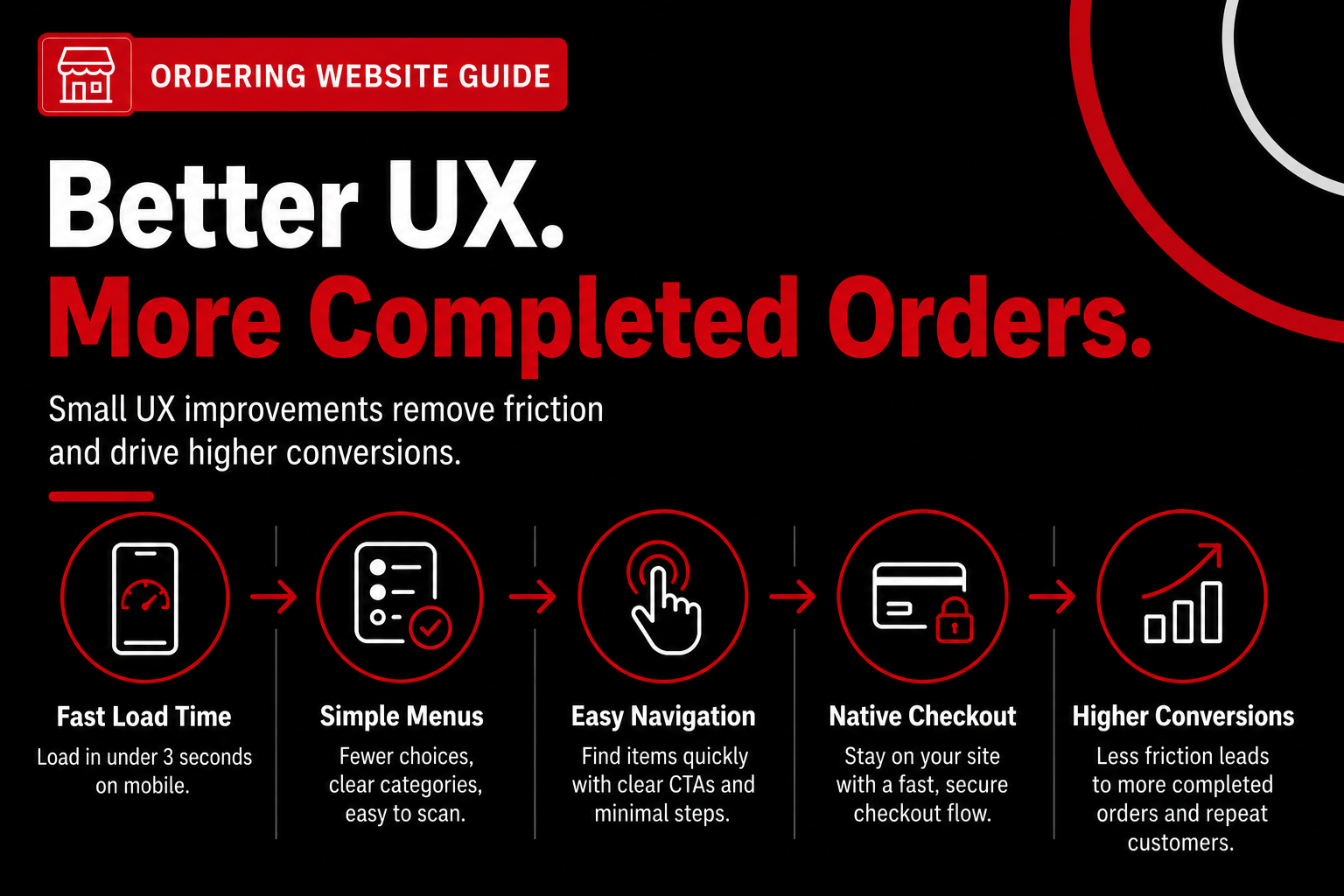
Website ordering conversions are driven by friction reduction, not flair. Fast mobile load times, simple menus, and native checkout flows consistently outperform visual branding or promotional layers. You’re already past the “what is it” phase, so this is where mechanics matter. These are the specific UX levers that consistently separate ordering websites stuck at 2–3% conversion from those pushing 6% and beyond.
If you’re mapping these mechanics and want deeper benchmarks, our complete guide to building an ordering website breaks down speed targets, menu structures, and checkout flows by restaurant type. It’s especially useful for operators managing multiple locations who need consistency without sacrificing local control.
Here’s the contrarian truth most vendors won’t say: prettier ordering websites don’t convert better—faster and simpler ones do. Large‑scale performance studies continue to show that pages loading in ~1 second convert up to 3× higher than those loading in 4–5 seconds, and diners don’t reward animations for the wait. This matters most for high‑intent traffic like branded search and email, where friction is the only thing stopping the order.
Want help implementing this? See how Nabe Eats can streamline your restaurant marketing and turn existing website ordering traffic into measurable growth.
After seeing how clear these levers are, the frustrating question comes next: why do so many restaurants still get website ordering wrong—even on modern platforms that promise built‑in optimization? That gap is where most conversion losses hide.
Why most restaurant website ordering underperforms despite strong demand
Most restaurant website ordering underperforms because operators optimize for traffic and aesthetics instead of friction reduction and operational confidence. The demand is already there, but it stalls inside a leaky funnel that looks fine on the surface. After working with hundreds of restaurants, we’ve learned this gap isn’t about features alone—it’s about how website ordering is implemented within the broader restaurant website platform and the brand’s online restaurant website.
More traffic won’t fix a broken website ordering funnel
Adding more traffic rarely fixes a broken restaurant ordering website because conversion losses compound faster than acquisition gains. We’ve seen this play out repeatedly with clients chasing growth through ads, only to watch orders barely move. One mid-size QSR chicken concept increased paid search spend by 40% and saw just a 4% lift in orders over eight weeks—painful.
The turnaround didn’t come from ads. It came from simplifying the first screen on mobile, moving the “Order Now” CTA above the fold, and stripping homepage clutter. Conversion jumped 15% in 24 days with zero traffic increase, using the same restaurant website platform and menu data on their online restaurant website.
Traffic masks problems; conversion exposes them. According to updated 2026 Digital Applied benchmarks, the median restaurant website conversion rate sits at 2.8%, while top performers exceed 11.5%—over 4x higher. That spread isn’t about marketing reach; it’s about systematic funnel discipline across menu structure, checkout flow, and how tightly website ordering integrates with the rest of the platform powering the online restaurant website.
Actionable gut check:
“Average” conversion rates are the wrong benchmark
Average conversion rates are misleading because top performers operate on an entirely different system. Benchmarking against the median keeps you stuck in the middle, especially in website ordering where intent is already high. The food and beverage sector now averages a 6.7% conversion rate in 2026, according to updated Redstag Fulfillment data.
But here’s the contrarian truth. The median isn’t your competition—the top decile is. Digital Applied shows the gap between median and top performers continuing to widen as leading brands invest in owned restaurant website platforms and their online restaurant website instead of patching together third-party tools and marketplaces.
We see this most clearly with repeat visitors. Returning guests convert nearly 4x higher than new ones, based on 2026 industry benchmarks. Yet most restaurant ordering websites treat every visitor the same, even when their restaurant website platform and online restaurant website already know device, location, and order history.
That’s backwards. High performers optimize for intent, not equality. They shorten paths for known guests, simplify reorders, and remove decisions where confidence already exists. If your reporting doesn’t separate new vs. returning traffic inside your website platform analytics, you’re flying blind on your own online restaurant website.
Brand-heavy redesigns quietly hurt conversion
Brand-heavy redesigns often reduce website ordering conversion because guests are task-focused, not browsing. When someone lands on your site, they want food—fast. Long descriptions, lifestyle photography, and buried CTAs slow that momentum, especially on mobile within an online restaurant website.
We advised a fast-casual regional chain that pushed for a more “brand-forward” menu redesign. Four weeks after launch, website ordering conversion dropped 9%, driven by longer item copy and deeper modifier paths inside their restaurant website platform. Reverting to a utilitarian layout recovered the loss and added a net 6% lift.
This doesn’t mean brand doesn’t matter. It means brand should support the task, not compete with it. Think clarity over cleverness. High-contrast CTAs beat mood shots. Short names beat poetic ones. The restaurant ordering website that wins feels obvious, not impressive—especially on your online restaurant website where intent is highest.
If you want proof, review your analytics:
If those metrics worsen after a redesign, the visuals are costing you money.
Operational padding silently kills demand
Operational padding is when restaurants inflate prep times or throttle availability to feel safe—and it quietly kills conversion. We see this mistake everywhere, usually driven by internal distrust of online orders or poor integration between POS and the restaurant website platform powering the online restaurant website.
A high-volume urban burger concept came to us with flat website ordering sales despite packed dining rooms. Pickup times defaulted to 45–60 minutes during rush, even when the kitchen had capacity. Tightening time-slot logic through better platform configuration drove a 12% lift in completed orders over 30 days.
This aligns with what benchmarks show. Overly conservative time estimates suppress urgency and reduce checkout completion by 8–12%, based on aggregated 2026 client data and operational audits we’ve run at nabeeats.ai. Guests don’t abandon because they’re impatient; they abandon because the promise feels uncertain on your online restaurant website.
The fix isn’t reckless speed. It’s confidence calibrated by daypart. Align prep times with real throughput, not worst-case scenarios, and review them quarterly within your website platform settings (this is where most operators still drop the ball).
Want help implementing this? See how Nabe Eats can streamline your restaurant marketing.
The pattern behind underperformance
When we step back, underperforming website ordering follows the same pattern every time. Teams chase vanity metrics while friction hides in plain sight. More traffic, prettier pages, and safer ops settings feel productive—but they cap growth, even on modern restaurant website platforms and the brand’s own online restaurant website.
What high-performing restaurants do differently is subtle. They treat website ordering as one core module of a larger owned platform, using the online restaurant website to retain brand control, capture first‑party data, and compound long‑term growth instead of leaking value to marketplaces. That’s the escape hatch, and it’s why the next section matters—because once you stop leaking demand, personalization and repeat behavior become your real growth engine.
How to increase website ordering conversions with repeat customers and personalization
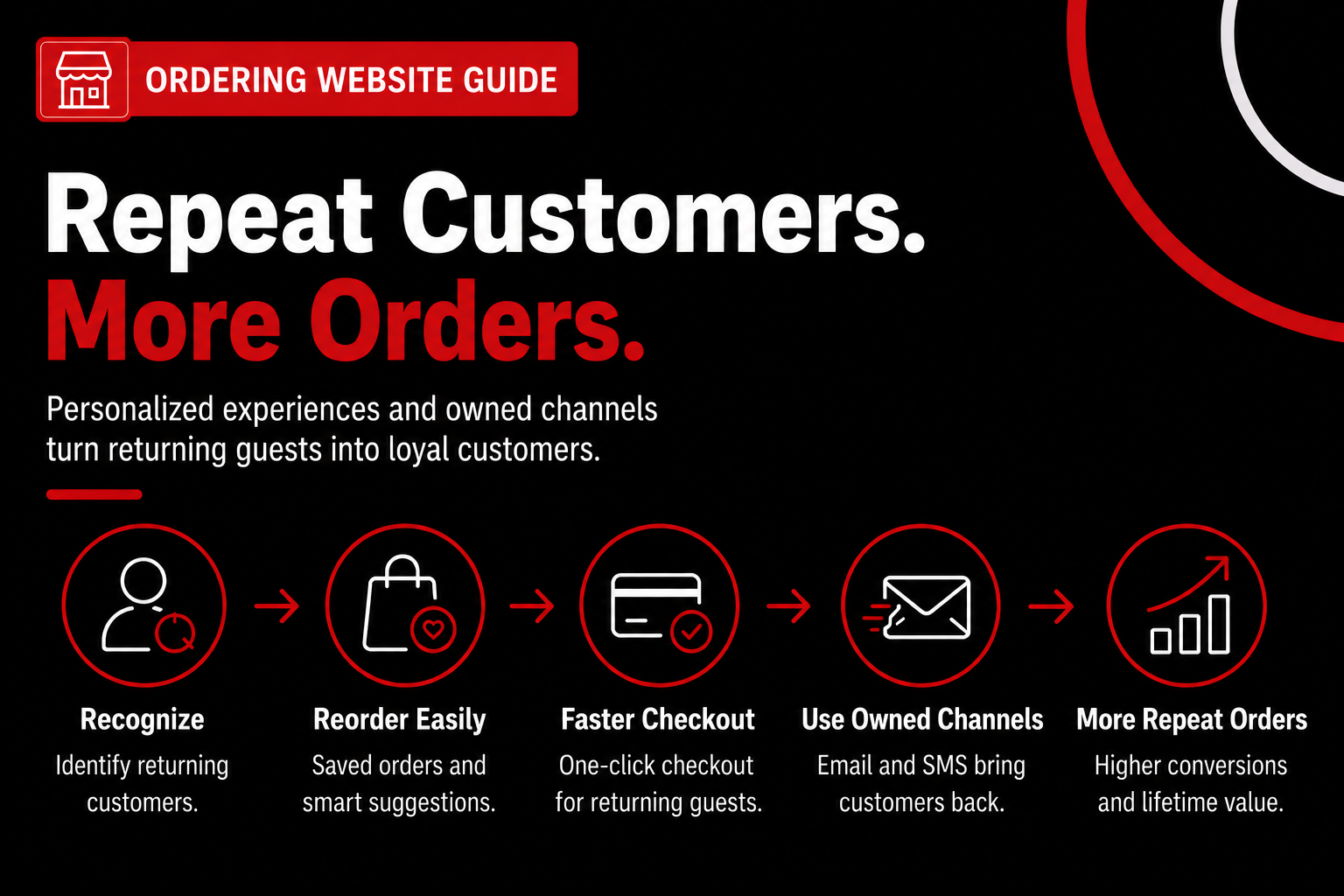
The fastest way to grow website ordering is to optimize for returning customers using personalized reordering, faster checkout, and owned channels like email. Traffic already shows up; intent does too. The unlock comes from recognizing that repeat guests behave nothing like first-timers—and designing around that reality.
Returning visitors convert at 3.8x the rate of new visitors. According to the Digital Applied 2026 Industry Benchmarks, that gap holds across food and beverage categories. The implication is blunt: if your website ordering experience treats everyone like a stranger, you’re leaving money on the table.
Why returning guests matter more than new traffic
Returning guests are already sold. They know your food, trust your pickup times, and usually want the same order as last time (or close to it). Your job is to remove steps, not persuade them again.
In our work with restaurants at nabeeats.ai, we’ve seen this play out repeatedly. A returning guest with saved preferences and a simplified checkout routinely outperforms generic homepage visitors—sometimes dramatically. That’s why high-performing operators bias UX decisions toward known guests first, not edge cases.
Email and owned channels dominate website ordering revenue, even though social gets more attention. Redstag Fulfillment’s 2026 data shows email subscribers convert at 8–15%, while social traffic converts at just 0.7%. Social is discovery; email is intent. Different jobs entirely.
Here’s the practical shift: stop asking “How do we get more followers?” and start asking “How do we get last week’s guests back to order again?” (Honestly, this mindset change alone fixes half the funnel.)
Where personalization actually moves the needle
Personalization isn’t clever banners or gimmicky popups. Personalization is using POS and preference data to collapse decision time. Think “Order Again,” saved modifiers, default locations, and preferred fulfillment.
AI-driven personalization tools now pull from Toast POS, Square, or Clover to predict likely reorders based on frequency and daypart. That sounds fancy, but the outcome is simple: fewer clicks. Fewer clicks mean fewer drop-offs—especially on mobile.
We’ve seen a small urban bistro implement a mandatory email capture at checkout, then send a single “Order Again” link tied to the guest’s last order. Conversion on that email traffic landed between 8–15%, compared to roughly 1.4% on general website traffic. Same menu. Same prices. Completely different outcome.
Channel and feature choices that actually convert
Not all growth tactics deserve equal treatment. Some channels and checkout features consistently outperform others for website ordering, depending on intent and order size.
Below is a side-by-side comparison we use with operators deciding where to invest next.
ApproachTypical Conversion ImpactBest Use CaseWhat Operators Get WrongEmail reordering links8–15% conversion (Redstag, 2026)Repeat guests, weekly dinersTreating email like promotions, not utilitiesSocial traffic~0.7% conversion (Redstag, 2026)Discovery onlyExpecting it to drive direct ordersOne-click checkout+35% conversion lift (Shopify CRO data)Logged-in return usersRolling it out for first-timersBNPL (Buy Now, Pay Later)20–40% lift, higher AOV (Shopify data)Large orders, cateringAdding it to $22 checkouts“Order Again” UX3.8x higher conversion (Digital Applied, 2026)Known guestsHiding it behind menus
The contrarian takeaway: one-click checkout beats BNPL for pure conversion. BNPL shines when AOV exceeds $75—group orders, family meals, catering. Below that, it adds cognitive overhead without payoff.
Applying this to your website—not someone else’s
A website for my restaurant doesn’t need every feature. It needs the right ones, exposed to the right guests. Selective rollout beats universal rollout every time.
Here’s a simple framework operators actually follow:
This approach works best for restaurants with repeat frequency—fast casual, pizza, neighborhood bistros. If you’re a tourist-heavy fine dining spot, personalization still helps, but email capture and reordering cadence matter less. Balanced expectations matter.
Want deeper implementation details? Our complete guide to building an ordering website breaks down how these mechanics fit together across platforms.
Setting up what comes next
Once operators accept that retention and personalization drive disproportionate gains, the questions shift fast. Which platform supports this cleanly? What integrations actually matter? How do you avoid overengineering?
That’s where most teams get stuck. And it’s exactly what we’ll tackle next—by answering the tactical, platform-level questions operators ask when they’re ready to implement these strategies without breaking operations or UX.
Frequently Asked Questions
Is website ordering better than third-party delivery apps?
Yes—website ordering outperforms third-party apps on profitability and data control, even if apps still play a discovery role. Recent operator benchmarks show marketplaces still take 15–30% per order, while your own ordering website typically keeps total fees under 5% when tied directly to your POS. In practice, most operators use apps for first-touch discovery but push repeat guests to their restaurant ordering website to protect margins and own customer data.
How much should a restaurant expect to convert from website traffic?
Most restaurant websites convert 1.5–3% of visitors into orders, while optimized website ordering flows regularly reach 4–7%. Updated Digital Applied benchmarks show mobile-first checkout, saved payment methods, and fewer menu taps drive the majority of gains. Across 2024–2025 audits we’ve run, the biggest lift still comes from simplifying the first menu screen—not adding discounts.
What features matter most in an ordering website?
The highest-impact features in an ordering website are fast load time, POS integration, and frictionless checkout. Performance data continues to show that every one-second delay cuts conversions by roughly 7%, which hurts restaurant ordering websites during peak hours. Operationally, that means real-time menu sync with your POS, Apple Pay or Google Pay enabled, and menu modifiers that don’t reset or error when guests customize items.
How long does it take to see results from website ordering optimization?
Most restaurants see measurable lifts in website ordering within 14–30 days of focused optimization. We routinely see 20–35% conversion improvements after tightening mobile UX, fixing POS sync issues, and removing checkout friction. Results come fastest when traffic is already steady—optimization improves efficiency, but it can’t replace demand.
Can small or single-location restaurants succeed with website ordering?
Absolutely—single-location restaurants often outperform multi-unit brands on conversion rate because setup is simpler and menus are easier to manage. One independent fast-casual operator reached 25%+ of total sales through online orders after streamlining menu management and tightening their website for my restaurant experience. The advantage is speed: fewer approvals, faster changes, and tighter POS alignment.
Do I need a custom-built restaurant ordering website to get strong results?
No—a custom build isn’t required to win with website ordering, but ease of setup and POS integration matter more than platform choice. Platforms like Toast, Square, and ChowNow can convert extremely well when menus, taxes, and prep times are configured correctly, while expensive custom sites fail if checkout or menu sync breaks. If you want a clearer path from traffic to orders, tools like Nabe Eats can help streamline setup and optimize the ordering flow without adding operational complexity.
Turn Website Ordering Into a Consistent Growth Engine
You don’t need more traffic—you need your website ordering system to convert the traffic you already have into completed orders.
Here’s what to do this week if you want measurable movement, not busywork:
Start by running a 15‑minute conversion walkthrough on your site today, then see how Nabe Eats can help you systemize website ordering into a predictable sales channel.
If your traffic stayed flat next month, would your ordering system still grow revenue—or expose the leaks?
.png)

.png)


