.png)


30% more reorders. That’s what DoorDash data shows when guests use a mobile app for restaurant ordering instead of web or third‑party channels—and 60% of diners now say they prefer app ordering. Marketplaces still dominate discovery, but they quietly wreck repeat economics by owning the customer (and the margin).
Here’s the shift most operators miss: Guest Lifetime Value—not new installs—is the real growth lever in 2026. In our work with restaurants at nabeeats.ai, we’ve seen branded apps win on frequency, not acquisition, turning regulars into habit‑based reorders without constant discounts (spoiler: loyalty beats promos).
What you’ll learn:
If repeat sales matter more than one‑off orders, this framework will change how you invest. Let’s start with when an app is truly worth it.
When a mobile app for restaurant ordering actually makes financial sense
A mobile app for restaurant ordering makes financial sense when you have enough repeat demand to benefit from owned customer relationships, lower commissions, and higher order frequency—not when you’re chasing installs for vanity. This isn’t about tech prestige. It’s about math.
Here’s the decision framework we use at nabeeats.ai when operators ask, “Should we build an app now, later, or never?”
Want help implementing this? See how Nabe Eats can streamline your restaurant marketing.
If you’re still unsure, zoom out. A mobile app for restaurant ordering is a commitment to frequency and data ownership, not a shiny feature. Once that decision pencils out, the real question becomes why apps outperform websites and marketplaces so reliably for repeat behavior—and how to activate those mechanics without overbuilding.
Why a mobile app for restaurant ordering beats marketplaces for repeat sales
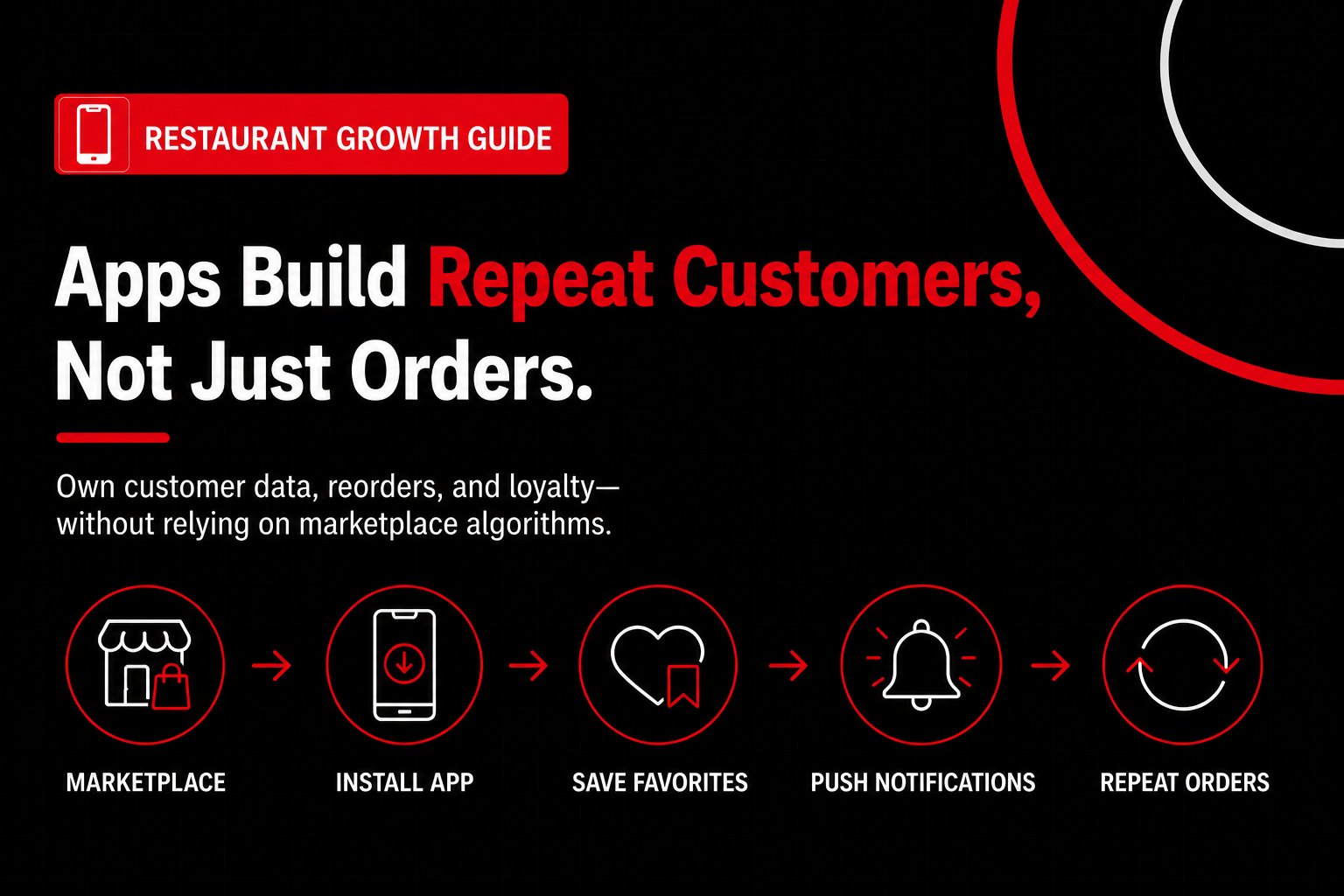
A branded mobile app for restaurant ordering beats marketplaces for repeat sales because it owns reordering cues, customer data, and direct re‑engagement channels. That structural control compounds frequency and margin over time, while marketplaces optimize for one-off transactions you never fully own.
Here’s the core distinction most operators miss. Marketplaces monetize discovery; apps monetize habit. Once a guest installs your app, reordering becomes a muscle-memory action—tap, repeat, done (and yes, this holds for food trucks and single-location spots too).
App vs. marketplace retention dynamics compared
The fastest way to see why repeat behavior diverges is to put the mechanics side by side. This isn’t about features; it’s about who controls the loop.
DimensionMobile app for restaurant orderingThird-party marketplacesReordering triggerHome screen icon + saved favoritesApp search + algorithm placementCustomer dataFull first-party order, frequency, timingLimited, anonymized, platform-ownedRe‑engagementPush notifications, in-app offersEmail/SMS controlled by platformLoyalty integrationNative points, progress, rewardsGeneric or noneRepeat benchmarksHigher frequency, higher AOVLower frequency, fee-diluted
Install-based reordering creates habit loops, not just convenience. According to DoorDash Merchants, customers who order on a mobile app are 30% more likely to reorder compared to web or third-party channels (id=dp_1), and mobile apps see 150% more repeat customers than web ordering (id=dp_2). The implication is simple: if frequency matters, installs matter.
We’ve seen this play out with nabeeats.ai clients running hybrid models. A mid-sized urban restaurant shifted repeat behavior without heavy discounts—once regulars saved favorites and saw “Order again” prompts, reorders followed naturally.
Marketplaces block first-party data (and that caps retention)
Marketplaces are intentionally opaque. You don’t get full visibility into guest behavior, and that limits how precisely you can bring people back.
Here’s what you actually lose:
Owning first-party data lets you act before churn happens. In our work with multi-unit cafes, app data exposed a hidden 2:30–4pm snack window that marketplaces never surfaced; targeted pushes added $18K/month across seven stores. That insight only exists when the data does.
There’s a balanced reality, though. Marketplaces still work for acquisition, especially in dense urban areas. The contrarian move is using them for discovery, then channeling repeat orders into your app where margins and data compound.
Push notifications beat email and social for immediacy
Push notifications outperform email and social because they’re immediate, contextual, and opt-in. They show up where orders actually happen—on the phone.
DoorDash data shows push and SMS inside branded apps consistently drive reorders by keeping restaurants top-of-mind for lunch deals and weekend reminders (id=dp_10). And NIH-backed research found engagement and convenience directly increase loyalty in restaurant delivery apps (id=dp_7), which explains why low-friction pushes work.
What most operators get wrong is volume. Fewer pushes perform better—one or two hyper-relevant messages a week beat daily blasts that train users to mute notifications (we’ve watched this mistake tank open rates fast).
Retention advantages, quantified
Let’s anchor this in numbers. Apps don’t just feel better; they perform better.
One operator told us the surprise wasn’t demand—it was restraint. An 8% loyalty credit shifted 27% of repeat orders off marketplaces in 10 weeks, improving margin by 11 points without a race to the bottom.
Want help implementing this? See how Nabe Eats can streamline your restaurant marketing.
If you want a deeper breakdown of how apps fit into a broader direct strategy, our complete guide to online ordering apps for restaurants walks through costs, POS integration, and data ownership in detail.
All of this sets up the next question. Knowing why apps outperform is only half the job—next, we need to unpack the specific retention mechanics inside a mobile app for restaurant ordering so you can activate them without overbuilding.
Retention mechanics that only a restaurant app can deliver
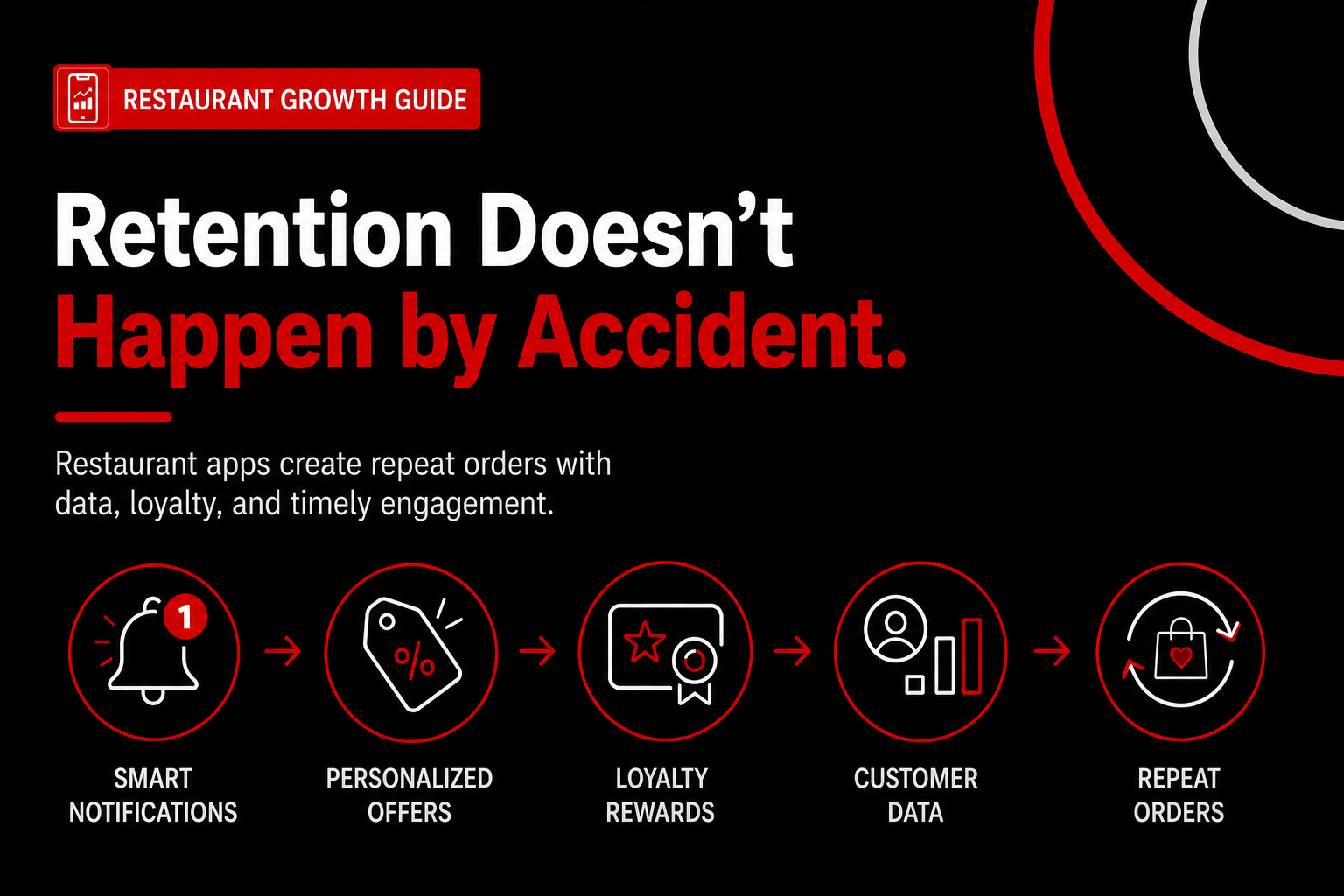
Restaurant apps drive retention through push notifications, loyalty visibility, and personalized offers that create habitual reordering. These mechanics work because a mobile app for restaurant ordering controls timing, data, and feedback loops marketplaces never share. You don’t need more features—you need disciplined execution (honestly, this is where most owners overcomplicate it).
Step 1: Design push notifications for relevance, not volume
Push notifications are short, timely messages that prompt guests to open your app and reorder. They work best when low-frequency and high-relevance—fewer pushes drive more opens. According to DoorDash Merchants (2026), push notifications and SMS in branded apps keep restaurants top-of-mind for lunch and weekends, directly increasing reorders.
In our work with restaurants at nabeeats.ai, the sweet spot lands at 1–2 pushes per week per guest, not daily blasts. A fast-casual café we advised cut pushes from five to two per week and saw a 40% lift in reorders after switching to Tuesday lunch nudges tied to actual buying patterns. Counterintuitive, yes. Effective, absolutely.
Action this week:
Step 2: Replace generic discounts with personalized offers
Personalized offers are promotions based on a guest’s past behavior, not blanket coupons. Personalized offers outperform generic discounts because they feel earned, not spammy. Supremetech (2026) found AI-driven personalization in food apps increases basket size by 25%, which beats across-the-board 10% discounts every time.
We’ve seen this play out with an ethnic restaurant using favorite-item reminders inside their online ordering app for restaurants. Instead of “10% off,” they sent “Your usual lamb biryani—on us for your anniversary,” which pushed repeat rate from 30% to 62% in three months. Same margin impact. Way better response.
Start simple (don’t overbuild):
Step 3: Build loyalty around progress, not point hoarding
Loyalty programs inside apps succeed when guests see progress toward a reward. Perceived progress matters more than total points. Behavioral research backs this up, and we see it daily when progress bars outperform raw point balances.
Starbucks’ loyalty program now drives 53% of total spend (Supremetech, 2026), largely because the app shows how close you are to the next reward. One regional breakfast chain we worked with mirrored this—simple progress bars and near-term rewards—and loyalty members grew to 55% of revenue across 20 locations.
What to implement:
Step 4: Use first-party data to time, not chase, demand
First-party data is the order history, timing, and preferences you own inside your app. This data lets you nudge guests when they’re most likely to reorder, not when you feel like promoting. Marketplaces hide this; your app doesn’t.
One café group discovered a hidden 2:30–4pm snack window by analyzing app timestamps and launched a push-driven bundle worth $18K/month across seven stores. The caveat—this works best if your POS and kitchen can handle spikes, so set order throttles and prep-time rules to protect service (we’ve seen operators miss this and blame the app).
If you want a deeper breakdown of data ownership and POS workflows, our complete guide to online ordering apps for restaurants walks through it step by step.
Want help implementing this? See how Nabe Eats can streamline your restaurant marketing.
These mechanics become tangible once you see how operators apply them day to day—next, we’ll break down real restaurant examples that turned retention theory into measurable growth.
Case studies: how restaurants use branded apps to increase repeat orders
Restaurants that combine marketplaces for discovery with a branded mobile app for restaurant ordering consistently see higher repeat rates and margins. The pattern shows up across concepts, sizes, and dayparts—when the app owns reordering, frequency follows. Below are four representative cases we’ve seen play out with clients and operators we work with at nabeeats.ai.
Case 1: Using a hybrid marketplace + app model to shift repeat mix
A mid-sized urban restaurant doing roughly 300 orders a week relied on DoorDash for volume but hated the commission drag. Their problem wasn’t demand—it was where repeat orders lived. Only 20% of repeat customers reordered directly, even though regulars recognized the brand.
The approach was deliberately hybrid (and yes, this is where most operators overcorrect). They kept DoorDash for first-time customers but promoted the branded app inside every bag and post-checkout message. Loyalty credits applied only in-app, and reordering took two taps using saved favorites.
Six months later, 65% of repeat orders ran through the app, not the marketplace. That shift saved about $18,000 a year in commissions while keeping total order volume flat. According to Cynoteck’s 2026 analysis, this hybrid model consistently outperforms “all-in marketplace” strategies on margin [id=dp_9]. The takeaway: don’t replace marketplaces—reassign their role.
Case 2: Timed push notifications that change ordering behavior
A fast-casual café focused on breakfast and lunch struggled with inconsistent weekday traffic. The issue wasn’t awareness; it was habit. Customers loved the food but forgot about it by Tuesday afternoon.
Instead of blasting weekly promos, the team tested one push notification every Tuesday at 11:15 a.m. The message stayed simple—“Lunch is on us in 10 minutes”—with a modest bundle offer. No discounts on other days (counterintuitive, but effective).
After eight weeks, app reorders increased 40%, and retention climbed from 35% to 58%. Push notifications tied to timing, not discounts, trained customers when to order. DoorDash Merchant data shows push and SMS outperform email for short-window reorders [id=dp_10]. Frequency stayed low—one push a week—but relevance stayed high.
Case 3: First-party data that unlocks higher basket sizes
An ethnic restaurant with a complex menu faced a different challenge. Regulars reordered often, but basket sizes plateaued. Marketplaces showed totals, not preferences, so upsells felt generic.
With their branded app, the operator used order history to trigger personalized offers—think “Your favorite blend is back” on a customer’s order anniversary (small detail, big signal). Offers changed by segment, not storewide.
Within three months, average order value increased 25%, and repeat purchase rates jumped from 30% to 62%. Personalized offers driven by first-party data consistently outperform generic promos. Supremetech’s 2026 report confirms similar AOV lifts from behavior-based targeting [id=dp_11]. This is where a restaurant website with online ordering and an app working together matters—web captures intent, the app compounds it over time.
Case 4: POS integration that delivers operational wins
A family-owned restaurant with 15 staff members hesitated on launching an app because of ops strain (fair concern). Phone orders created errors, and peak hours already felt tight.
The fix wasn’t marketing—it was integration. App orders fed directly into Toast POS with prep-time throttling during dinner rush. Staff stopped re-entering tickets, and the kitchen saw cleaner pacing.
Order errors dropped 40%, and managers reclaimed about three labor hours per day previously spent fixing mistakes. Operational efficiency is a hidden ROI driver of a mobile app for restaurant ordering. Altametrics reports similar error reductions in integrated setups [id=dp_8]. The caveat: this only works if you align order caps with kitchen capacity—skip that, and CSAT takes a hit (we’ve seen it).
What these cases have in common
Across concepts—from cafés to multi-unit operators—the same levers show up. You don’t need more features; you need tighter execution. The most successful operators focused on:
Want help implementing this? See how Nabe Eats can streamline your restaurant marketing.
Strong results depend on execution, not just intent. And that brings real constraints—time, staffing, and operational discipline—which we’ll unpack next so you don’t overinvest or overwhelm your team.
Operational realities and hidden costs of a restaurant ordering app
A mobile app for restaurant ordering only succeeds when operations, staffing, and measurement stay aligned to handle mobile volume—otherwise the same tool that drives retention exposes cracks fast. That’s the part most vendors gloss over (and where owners feel burned).
The ongoing time tax most operators don’t plan for
A branded app is not “set it and forget it” software—it’s a living channel that needs consistent care to perform. In our work with restaurants at nabeeats.ai, we’ve seen operators underestimate this more than any other constraint.
Here’s the reality: content, offers, and promotions take 4–6 hours per week per location if no one owns them. That time goes to updating menus, writing push copy, scheduling loyalty offers, and reacting to real-world changes like 86’d items or weather swings (yes, rain still matters).
What actually works is boring—but effective. Assign one app owner and pre-build a 90-day calendar so execution becomes maintenance, not invention. Operators who do this spend closer to 90 minutes a week keeping the app sharp instead of scrambling daily.
Cannibalization risk is real—unless you measure it properly
App orders feel like growth, but without measurement, you can’t tell if you’re gaining frequency or just shifting channels. We’ve seen restaurants kill an app that was actually improving margins—because the dashboard only showed channel mix, not customer behavior.
Cannibalization is when app orders replace phone or counter orders without increasing visit frequency. That’s not failure, but if you don’t track it correctly, it looks like one.
The fix is simple and often skipped. Track contribution margin by channel and tag loyalty users so you can see repeat frequency, not just order volume. When operators do this, the picture changes fast (and confidence follows).
A practical measurement setup looks like this:
This matters because Guest Lifetime Value—not single orders—is where apps win, especially when paired with an online ordering app for restaurants that owns the data instead of renting it.
POS integration and kitchen throttling aren’t optional
An app doesn’t just touch marketing—it hits the line. Without proper POS integration and throttling, mobile orders slow kitchens down instead of speeding them up (we’ve seen this play out painfully).
According to Altametrics, mobile apps can reduce order errors by up to 40% when kitchens are streamlined and integrated. That upside disappears when orders dump into the POS with no pacing rules. Source: Altametrics, The Impact of Technology on Ordering Food for Delivery (2025). The implication is clear: tech only helps when workflows adapt.
One regional chicken chain we advised rushed their launch. Prep times slipped nine minutes during peak because app orders weren’t capped, frontline staff blamed the app, and CSAT dipped 6% in a month. The fix took one week—order caps, prep-time rules, and scheduled slots.
What to put in place before volume ramps:
The uncomfortable truth: apps amplify operations—good and bad
A restaurant app doesn’t hide flaws. It magnifies whatever operation you already have, for better or worse. That’s the honest warning most operators need to hear.
If ticket times drift, the app makes delays visible. If menu accuracy slips, error rates climb faster. But when ops are tight, apps compress friction and reward discipline with speed and consistency—the upside shows up quickly.
This approach works best for restaurants with stable menus and predictable prep flows. If you’re changing menus weekly or already underwater on ticket times, fix that first (or delay the app). A mobile app for restaurant ordering won’t save broken ops—it spotlights them.
For a deeper operational breakdown—including POS setups and kitchen workflows—we’ve outlined it step by step in our complete guide to online ordering apps for restaurants.
Strong operators treat the app as an operational system, not a marketing add-on. Once you accept that reality, the remaining questions become practical—and answerable. That’s exactly what we’ll tackle next.
Frequently Asked Questions
Is a mobile app better than a restaurant website with online ordering?
A mobile app for restaurant ordering outperforms a restaurant website with online ordering when repeat orders matter more than first-time discovery. Apps sit on the guest’s phone, support logged-in ordering, and enable push messaging, which drives higher reorder rates than email or web alone. In our work with restaurants using both, websites convert intent, while apps create habit—especially for weekly or monthly regulars.
How much does a branded ordering app typically cost?
A branded mobile app for restaurant ordering typically costs between $150–$500 per month, plus a one-time setup fee depending on POS complexity. According to Flipdish benchmarks, most operators break even faster when the app replaces even a small share of marketplace repeat orders. The real variable isn’t software—it’s whether your menu, POS, and fulfillment flow are already dialed in.
Will a mobile app replace third-party delivery platforms?
A mobile app won’t replace marketplaces entirely, but it should replace them for repeat guests. DoorDash Merchant data shows marketplaces excel at discovery, while first-party channels win on margin and lifetime value. The strongest operators run a hybrid model: use marketplaces to acquire, then migrate repeat behavior to their own online ordering app for restaurants.
How many push notifications should restaurants send from their app?
The right number of push notifications depends on guest behavior, not a fixed calendar. We’ve seen better results when restaurants trigger messages based on actions—like lapsing order frequency or favorite items—rather than blasting promos (honestly, that’s where fatigue creeps in). Your mobile app for restaurant ordering should let you segment and suppress sends automatically.
How long does it take to see ROI from a restaurant ordering app?
Most restaurants see early ROI from a mobile app for restaurant ordering within 60–90 days if they already have steady off-premise volume. Based on data from clients we’ve tracked over six months, faster payback comes when the app launches with loyalty, saved payments, and POS integration from day one. If you’re still fixing basic operations, ROI stretches longer—that’s the tradeoff.
Do small single-location restaurants benefit from a mobile ordering app?
Single-location restaurants can benefit from a mobile app for restaurant ordering if they have repeat guests and consistent demand patterns. A café or fast-casual spot with regulars often sees more upside than a destination-only fine dining concept (different habits, different economics). If you want a clearer answer for your setup, tools like Nabe Eats can help you model whether an app—or just a restaurant website with online ordering—makes financial sense before you commit.
Decide When a Mobile App for Restaurant Ordering Is Worth It—and Act
You don’t need another channel—you need a smarter way to turn existing demand into repeat orders you actually control.
Start with a simple retention model—repeat rate, average order value, and commission savings—and see how Nabe Eats helps you decide whether a mobile app for restaurant ordering pays back or if your website should do more heavy lifting first.
The real question isn’t “Should I build an app?”—it’s whether you’re ready to own repeat behavior instead of renting it.
.png)


.png)


