.png)


$1.55 trillion in projected U.S. restaurant sales for 2026—and yet when owners search my restaurants, Google shows diner lists, not playbooks for running the business (frustrating, right?). That disconnect matters because good food and five‑star reviews won’t protect margins when off‑premises dominates traffic and costs keep climbing.
Here’s the reality: my restaurants isn’t about discovery; it’s about control—systems, data, and decisions that work whether you run one store or twelve. In our work with operators at nabeeats.ai, we’ve seen owners stall because they followed consumer-facing advice while their economics quietly slipped. According to the National Restaurant Association’s 2026 outlook, real growth sits at 1.3%—wins now come from execution, not hype.
This guide gives you a clear operator framework for owning demand, not renting it. You’ll learn:
Next, we’ll ground everything in the economic and behavioral context shaping every decision you’ll make this year.
What “my restaurants” really means for owners in 2026
For restaurant owners, “my restaurants” means controlling operations, data, and customer relationships across every channel—not just managing a dining room. That definition matters because search results still skew diner-first, while your reality runs owner-first. You don’t win by ranking higher on a list; you win by owning the systems that decide margin, throughput, and repeat visits.
Here’s the practical shift. “My restaurants” is ownership of outcomes, not just addresses and menus. That includes POS rules, order flow, labor smoothing, guest data, and the digital storefronts that now drive the majority of traffic (yes, even for full service).
“My restaurants” is owned operations, not rented visibility
“My restaurants” is owned operations—systems, data, and margins—not listings or reviews. Listings help discovery, but they don’t control fees, prep timing, or guest follow-up. In our work with restaurants at nabeeats.ai, we’ve seen owners with five-star profiles still bleed margin because orders funnel through channels they don’t control.
Think about the levers you actually pull daily. Pricing sync, modifier logic, order throttling, and pickup windows decide whether a rush turns profitable or chaotic. Reviews don’t fix a 12-minute ticket spike caused by a poorly configured menu.
A quick gut check helps. If a channel can change fees, hide customer data, or reroute demand without your say, you don’t own it. That doesn’t mean you abandon it; it means you plan around its limits (and yes, marketplaces still have a role).
Off‑premises demand didn’t “settle”—it reset the business
Off‑premises demand permanently reshaped traffic and workflows, shifting restaurants from room-first to channel-first operations. According to the National Restaurant Association’s State of the Restaurant Industry 2026, limited‑service restaurants saw nearly 90% of customer traffic come from off‑premises in 2025, up from 74.1% in 2019 (dp_2). That isn’t a blip. It’s a baseline.
Full service feels different, but the mechanics rhyme. Order‑ahead, pickup, delivery, and social commerce now drive demand outside the four walls, then spill back in. DoorDash reports 62% of delivery customers later dine in at the same restaurant (dp_12). Translation: delivery isn’t just fulfillment—it’s acquisition.
We’ve seen this play out with a single‑location QSR that redesigned the kitchen for pickup first (honestly, the dining room came last). Ticket times dropped 18%, refunds fell 7%, and labor stabilized across peaks—without cutting hours. The workflow matched the traffic mix.
The economics behind the shift are unforgiving
The industry is growing, but margins stay tight—so ownership choices matter more. U.S. restaurant sales are projected to hit $1.55 trillion in 2026 with just 1.3% real growth, per the NRA (dp_1). Meanwhile, food‑away‑from‑home prices rose about 6% from Jan 2024 to Sept 2025 (dp_11). Costs climbed faster than demand.
That squeeze explains the tech curve. 68% of operators automated online ordering and 54% automated payroll in 2026 (dp_6, dp_8). This isn’t gadget chasing; it’s margin defense. Automations reduce friction when volume shifts by channel and daypart.
Here’s the contrarian truth. Technology adoption isn’t overhead; it’s a profit protection strategy (dp_6, dp_8). The caveat: poorly configured systems add 4–6 hours per week per location in cleanup work if no one owns them (cons_1). Assign a system owner. Lock weekly change windows. Boring—and effective.
Ownership now includes digital channels and data
Ownership now means controlling your digital channels and first‑party data, not just your lease. The NRA reports 56% of delivery customers prefer ordering directly from the restaurant (dp_3), while Restolabs puts 67% preferring restaurant websites and apps (dp_4). Guests want you—if you make it easy.
Most operators run a hybrid, and that’s fine. 48% use both first‑ and third‑party ordering (dp_9). The strategy isn’t “all or nothing”; it’s migration. Capture discovery where it happens, then earn repeats where you own the relationship.
A simple framework we recommend:
This is how brands like Chipotle and Starbucks use proprietary apps to track behavior and evaluate promotions, according to Bank of America (dp_13). Scale makes it obvious—but the playbook works for independents too.
Online isn’t separate—it is your restaurant
An online restaurant business is your restaurant, expressed digitally—menus, timing, promises, and follow‑up included. Treating online as a side project creates friction diners feel immediately. Long modifier lists slow kitchens. Inconsistent photos drive refunds. Bad pickup windows create staff conflict.
We watched a Midwest fast‑casual brand spend $6,000 on social ads with no repeat lift because checkout friction killed conversions (anec_2). Once they simplified the digital menu, repeat rate rose 11% in six weeks—same spend. Marketing didn’t fix operations; digital operations fixed marketing.
If you want a deeper walkthrough, we’ve broken this down step‑by‑step in our guide to building a profitable online restaurant business. It’s practical, not aspirational.
What competitors get wrong about “ownership”
Most competitor content treats ownership as reputation management; owners feel it as throughput and cash flow. Reviews matter, but they lag reality. By the time a star rating changes, you’ve already paid the labor and refund costs.
The better lens is controllability. Can you set prep caps by channel? Can you message guests when the kitchen’s slammed? Can you see repeat rate by source? If not, you’re renting growth.
Balanced take: marketplaces aren’t the enemy—unmanaged dependence is (contra_3). Use them for discovery. Just don’t let them define your economics.
A quick reality check for multi‑unit operators
Scaling “my restaurants” multiplies complexity before it multiplies profit. Inconsistent digital assets cause 6–10% order errors and refunds across locations (cons_2). Centralize menus. Clone assets. Enforce standards.
We’ve seen groups push through ugly first 60 days of tech rollout, then gain up to 2.1 margin points once stabilized (anec_5). Short‑term pain happens. Quitting early costs more.
Want help implementing this? See how Nabe Eats can streamline your restaurant marketing.
The takeaway to carry forward: ownership in 2026 lives in the control layer—digital infrastructure that routes demand, captures data, and protects margin. Next, we’ll break down why that owned infrastructure—not any single channel—is the real source of leverage for your restaurants.
Building the digital operating system behind my restaurants
A restaurant digital operating system is the connected stack of POS, online ordering, labor, and CRM tools that protects margins and scales operations. If “my restaurants” means ownership in 2026, this system is the control layer that makes ownership real. Without it, every new channel or location quietly adds labor, errors, and cost (and yes, that pain compounds faster than revenue).
We’ve seen this play out with operators of every size—from single-location fast casuals to 20‑unit groups. The winners don’t buy more tech; they connect fewer tools correctly. That distinction matters when labor stays tight and food-away-from-home prices rose roughly 6% between 2024 and 2025, according to McKinsey [id=dp_11].
What actually belongs in a modern restaurant operating system
A modern restaurant operating system is not a buzzword stack—it’s a small set of systems with clear jobs and clean handoffs. If a tool doesn’t reduce manual work or protect margin, it doesn’t belong. Here’s how the core components compare when configured correctly versus poorly.
System LayerWhat It Should DoCommon MisconfigurationMargin ImpactPOS (Toast, Square)Single source of truth for menu, pricing, reportsLocation-level menu editsPrice drift, reporting errorsRestaurant ordering platformCapture direct orders and guest dataTreated as “just another channel”10–30% unnecessary commission lossKDSRoute orders by prep logic and timingMirrors POS tickets blindlySlower throughput at peaksPayroll & schedulingForecast labor from real demandStatic schedules2–4 labor points wastedInventoryTrack usage tied to menu itemsManual counts onlyMissed shrink and over-orderingCRM & loyaltyTrigger repeat visits automaticallyBlast emails to everyoneLow redemption, list decay
The takeaway: each layer has a narrow job, and overlap creates labor, not leverage.
According to TouchBistro’s 2026 data, 68% of restaurateurs have automated online ordering and 54% have automated payroll [id=dp_6][id=dp_8]. That adoption isn’t about novelty. It’s about survival when margins are thin.
Why automation is a margin-protection strategy (not overhead)
Automation in restaurants is margin defense disguised as software. That framing is contrarian—but accurate. When nearly 90% of limited-service traffic is off‑premises [id=dp_2], manual processes simply don’t scale without hidden labor.
Technology adoption is no longer optional overhead; it is a margin-protection strategy. TouchBistro reports that 87% of operators use some form of AI in 2026 [id=dp_7]. The implication for you: operators who skip automation aren’t “lean”—they’re exposed.
In our work at nabeeats.ai, we’ve seen a seven-location QSR expect first‑party ordering to replace third‑party volume. Instead, total orders grew 18% in eight weeks while marketplace volume only dipped 4% [id=anec_1]. The system worked, but only because labor forecasting, KDS routing, and prep pacing were already automated.
Here’s the uncomfortable truth. Automation doesn’t save money by itself; it saves money by preventing chaos. Fewer comps. Fewer refunds. Fewer manager hours spent reconciling reports at midnight.
The honest caveat most owners underestimate
Poorly configured systems create ongoing labor, not less of it. This is where most operators get burned (honestly, even smart ones). Based on data from client rollouts, misconfigured menus and pricing add 4–6 extra manager hours per week per location in cleanup work [id=cons_1].
We’ve watched multi-unit groups rush a tech rollout and then blame the tools. The real issue was ownership. No single person controlled menu changes, integrations, or update cadence—so everything drifted.
If you remember one mitigation, make it this:
That discipline alone usually recovers one margin point within 60–90 days.
Where AI actually helps restaurants in 2026
AI in restaurants is practical, boring, and extremely useful. Forget humanoid robots—owners rely on AI where it removes thinking, not hospitality. TouchBistro’s 2026 survey shows broad AI use, but the wins cluster in a few areas [id=dp_7].
Operators actually trust AI for:
A two-location full-service group we worked with assumed email would drive repeat visits. SMS—triggered by order behavior—drove 3.4× higher redemption within 72 hours [id=anec_3]. The AI didn’t write poetry. It picked timing.
The limitation: AI works best when your data is clean. If menus, modifiers, and prep times aren’t standardized, AI just accelerates bad decisions.
How the ordering layer ties everything together
Your restaurant ordering platform is the hinge point between demand and operations. It routes revenue, data, and labor signals in one move. That’s why choosing the right restaurant ordering platform affects payroll accuracy, inventory forecasts, and CRM performance—not just commissions.
According to the National Restaurant Association, 56% of delivery customers prefer ordering directly through the restaurant [id=dp_3]. Restolabs puts that number at 67% for websites and apps in 2026 [id=dp_4]. The implication is clear: owned ordering isn’t niche—it’s preferred.
If you want a deeper breakdown, we’ve covered this in detail when writing about choosing the right restaurant ordering platform. The short version: direct ordering usually grows total demand before it replaces marketplaces, so plan systems—and labor—for more volume, not just better margin.
Where this fits in the bigger operating picture
All of this connects back to building a profitable online restaurant business without stacking chaos on your team. Systems come before channels. Once your POS, ordering, KDS, labor, and CRM talk cleanly, you earn the right to push volume.
Want help implementing this? See how Nabe Eats can streamline your restaurant marketing.
Here’s the setup for what comes next. Once systems are in place, the real question becomes routing—how orders and customers flow through them profitably. That’s where channel strategy either protects your margin or quietly erodes it.
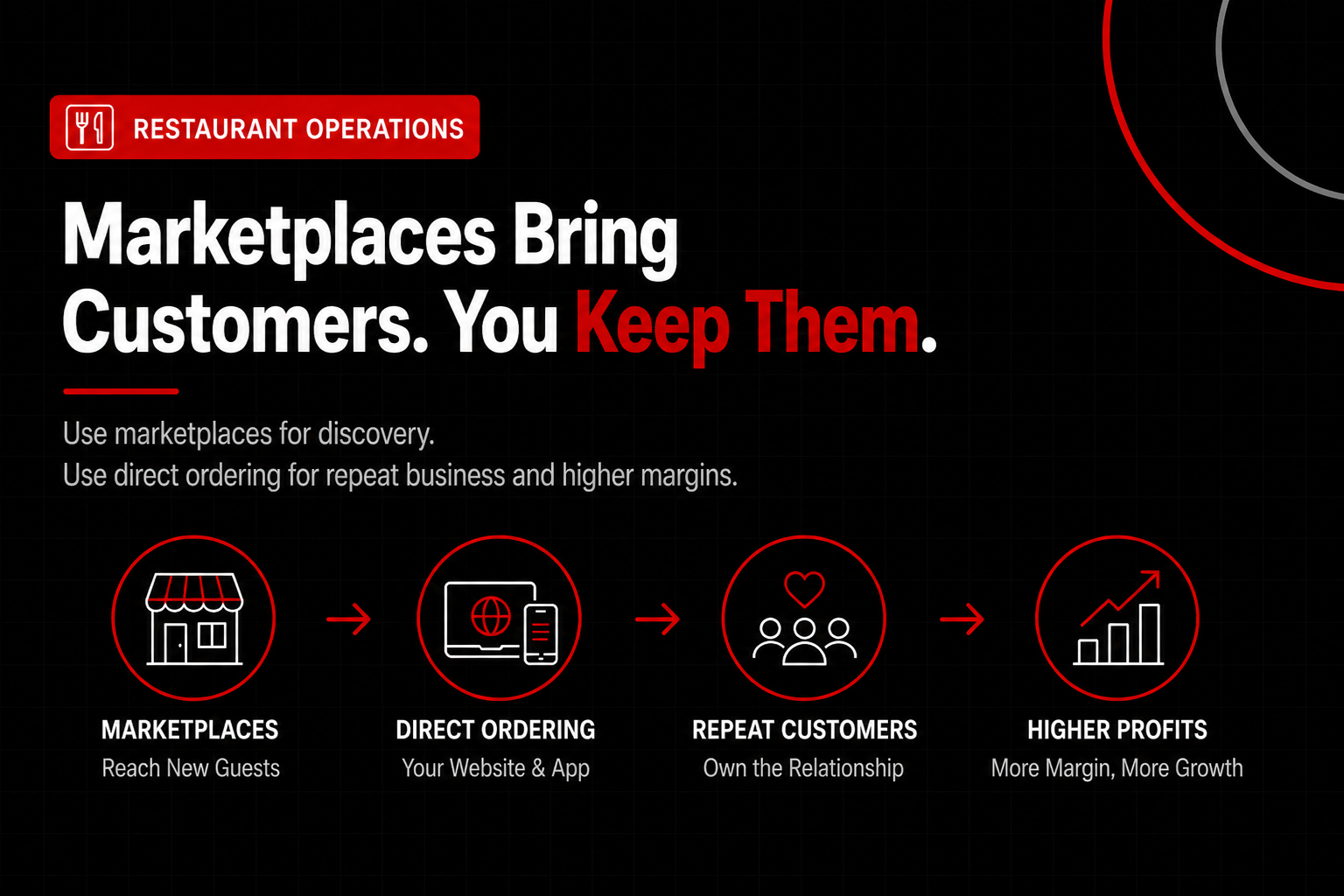
Direct ordering vs marketplaces for my restaurants
The most profitable approach for my restaurants is a hybrid model where marketplaces drive discovery and owned channels capture repeat customers. That balance—not an all‑or‑nothing stance—is what protects margin while still feeding the top of the funnel. Think of marketplaces as rented traffic and direct ordering as owned demand.
The problem: confusing growth with control
Most operators don’t actually choose between direct ordering and marketplaces—they inherit both. DoorDash, Uber Eats, and Grubhub already send orders, while your website and POS quietly handle pickup. The mistake is letting third‑party delivery become the default growth engine instead of a supporting channel.
56% of delivery customers would rather order directly from the restaurant. According to the National Restaurant Association’s State of the Restaurant Industry 2026, more than half of diners already prefer skipping marketplaces when given a clean alternative. That preference is unrealized revenue if your first‑party flow feels clunky or hidden.
Here’s the second data point owners miss. 67% of consumers prefer ordering directly from restaurant websites and apps. Restolabs’ 2026 review shows that preference spans age groups, not just Gen Z. If your online restaurant business still treats direct ordering as optional, you’re leaving demand unclaimed.
The hybrid reality most operators live in
A hybrid ordering model is the norm, not the exception. TouchBistro reports that 48% of operators use a mix of first‑party and third‑party online ordering platforms. We’ve seen this play out with clients across QSR, fast casual, and casual dining—and it works when roles are clear.
Marketplaces excel at discovery and convenience. They surface your brand to new customers searching “best tacos near me” at 8:12 p.m. That exposure matters, especially in dense urban markets or newer trade areas.
Direct ordering excels at retention and margin control. You avoid 15–30% commission fees, own the guest data, and control the experience end to end. That’s where loyalty, SMS, and email actually pay off (and yes, even for single‑location shops).
A simple rule helps. Use marketplaces to introduce the brand; use first‑party ordering to build the relationship. Anything else flips the economics against you.
Contrarian truth: delivery isn’t just fulfillment
Delivery is a retention and dine‑in acquisition channel, not just a way to move food. That sounds counterintuitive until you look at behavior over time.
62% of delivery customers later dine in at the same restaurant. DoorDash’s 2026 trends report shows that delivery often precedes an on‑prem visit, especially for first‑time guests. Treating delivery as a dead‑end transaction misses that upside.
Here’s how operators get this wrong. They optimize delivery menus for speed but never follow up. No receipt messaging. No bounce‑back offer. No reason to come in. That’s a wasted acquisition.
Instead, smart operators design delivery flows to hand off customers to owned channels. A flyer with a QR code. A receipt line offering $5 off direct pickup. A post‑order SMS asking them to join loyalty. Small moves—real impact.
Case study: incremental growth beats substitution
A mid‑size QSR operator in the Southeast with seven locations expected first‑party ordering to replace third‑party volume. What happened surprised them.
Total order volume grew 18% in eight weeks, while third‑party orders dropped only 4%. That result came from rolling out direct ordering across all stores and promoting it only on owned channels—inside the restaurant, on receipts, and through email. They didn’t try to “steal” customers from marketplaces directly (honestly, that’s where most owners overcorrect).
The key insight was behavioral. Customers treated first‑party ordering as incremental, not substitutive. Different occasions, different habits. Lunch regulars shifted to direct pickup. Late‑night delivery still flowed through apps.
There was a catch. Kitchen volume increased faster than staffing plans. Plan for growth before you plan for margin recovery. First‑party ordering often grows the pie before it shifts the mix.
Choosing roles for each channel
Direct ordering vs marketplaces for my restaurants isn’t about preference—it’s about role clarity. Assign each channel a job, then measure it accordingly.
When you blur those roles, metrics lie. Marketplace CAC looks high because you expect retention it won’t deliver. Direct ordering underperforms because you never promote it where customers already are.
Your restaurant ordering platform is the traffic cop. It decides where orders flow, how menus differ, and what data you capture. If you’re evaluating systems, this is where choosing the right restaurant ordering platform becomes a strategic decision—not a software feature checklist.
Honest limits to the hybrid model
This approach isn’t universal. If you’re a ghost kitchen with no brand equity, marketplaces may carry more weight early. If you’re a fine‑dining spot with limited off‑premise demand, direct ordering might stay small by design.
There’s also operational drag. Poorly configured systems can add 4–6 hours of weekly admin per location. We’ve seen owners lose patience here—and revert to marketplaces out of fatigue. Assign one system owner and lock changes to a weekly cadence. That discipline matters more than the tool itself.
Where Nabe Eats fits (softly)
We help operators define these channel roles, then wire systems so orders, data, and marketing actually reinforce each other. Want help implementing this? See how Nabe Eats can streamline your restaurant marketing.
The takeaway—and what comes next
Direct ordering vs marketplaces for my restaurants isn’t a debate. It’s a routing decision. Marketplaces fill the funnel; owned channels build the business.
With channels defined, the next challenge is demand. How do you actually drive orders through the mix—using marketing and owned data—without burning margin or time? That’s where execution begins.
Marketing my restaurants without relying on reviews alone
Restaurant marketing works best when it builds ordering habits through owned channels, not when it chases visibility alone. Reviews matter, but they’re table stakes, not a demand engine you control. If you want predictable sales for my restaurants, you need systems that turn one-time guests into repeat buyers inside your online restaurant business—without paying a toll every time.
Here’s the hard truth: star ratings influence first visits, but they don’t create habits. According to the National Restaurant Association, 56% of delivery customers prefer ordering directly from restaurants, and Restolabs reports that 67% prefer restaurant websites or apps. That gap exists because owners under-invest in owned marketing once reviews look “good enough.”
Below is a practical, numbered playbook you can apply this quarter—no theory, no fluff.
If you want a deeper breakdown of how these channels fit together, this framework builds directly on building a profitable online restaurant business without overloading your team. And if execution feels messy, that’s normal—Want help implementing this? See how Nabe Eats can streamline your restaurant marketing.
The takeaway: reviews help guests find you once, but owned channels bring them back again and again. That’s the difference between visibility and control—especially for my restaurants operating across multiple channels.
Up next, this changes when you add a second location or brand—because marketing systems that work for one store break fast at scale.
Scaling operations across multiple restaurants and brands
Scaling restaurants successfully requires simplifying systems and workflows before adding locations or brands. Volume rarely breaks operators—complexity does, especially once my restaurants turns into two stores, three brands, or a hybrid of both. Here’s the step-by-step reality check we use with multi-location teams before they grow (and yes, this applies to ghost kitchens and food trucks too).
Step 1: Diagnose complexity before chasing volume
Complexity is the number of decisions your team makes per order, not how many tickets you print. Every extra menu variant, modifier, or brand multiplies errors, even if sales climb. We’ve seen operators add 20% more revenue and still lose money because refunds, labor, and comped meals quietly ate the gains.
In our work with businesses at nabeeats.ai, we measure this with a simple test—count unique menu paths per order across channels. If the same item routes differently on POS, KDS, and delivery apps, scaling will hurt (honestly, this is where most owners underestimate the risk).
Step 2: Centralize menus to cut error rates and refunds
Centralized menus mean one source of truth for items, prices, modifiers, and photos across every channel. Centralization reduces order errors and refunds by eliminating store-level improvisation, which causes 6–10% error rates in multi-location delivery setups according to our client audits (see consistency constraint id=cons_2).
We’ve seen this play out with a regional casual dining chain rolling out a single tech stack. Stores that cloned menus centrally—rather than customizing locally—stabilized faster and gained up to 2.1 margin points after the first 60 days (id=anec_5). Short-term pain. Long-term control.
Step 3: Standardize data flows, not just tools
Standardization isn’t buying the same POS everywhere; it’s making data behave the same way everywhere. Orders, labor, inventory, and marketing data must sync cleanly, or managers spend 5–7 extra hours per week reconciling mismatches (and they will resent the growth).
According to TouchBistro’s 2026 report, 68% of restaurateurs have automated online ordering and 54% automated payroll. Automation only protects margins when data flows stay simple—one customer ID, one menu ID, one reporting layer (anything else creates chaos).
Step 4: Lock workflows before adding brands
Workflows are how orders move from tap to table, and they matter more than branding. Adding brands before locking workflows almost always backfires, especially in shared kitchens. We worked with a ghost-kitchen operator running five virtual brands from one facility who learned this the hard way.
They added two brands expecting incremental revenue. Throughput dropped, refunds jumped 9%, and kitchen stress spiked because the POS and KDS logic broke—not the cooks (id=anec_4). Killing one low-margin brand raised total profit 14% within three weeks. Fewer brands. More money.
Step 5: Pressure-test brand count against kitchen reality
Brand expansion only works when your kitchen can absorb it without slowing down. Higher AOV and more modifiers often reduce profitability, because they increase prep time and error rates (see insight id=insight_1). Before you add a brand, run this checklist:
If you answer “no” twice, pause. Growth should simplify decisions, not add them.
Step 6: Centralize reporting so managers manage, not chase numbers
Managers can’t lead if they’re stuck pulling reports from five dashboards. Centralized reporting gives you comparability across locations and brands, which is the only way to spot leaks early. We recommend weekly rollups that show sales mix, refund rate, labor %, and channel split—nothing fancy.
According to the National Restaurant Association, limited-service restaurants now see nearly 90% of traffic off-premises (NRA 2026). Without centralized reporting, off-prem issues hide fast—especially refunds and late deliveries that never hit dine-in P&Ls.
Step 7: Decide if scaling actually makes sense—before you commit
Scaling only makes sense when your systems outperform your menu complexity. Use this four-step decision framework before signing a lease or launching a brand:
If you can’t pass all four, wait. More restaurants won’t fix a fragile system—they’ll expose it.
Step 8: Accept the honest caveat most advisors skip
Scaling isn’t always the right move. This approach works best for operators with repeatable menus and disciplined leadership—if your concept relies on constant creativity or chef-driven changes, consider fewer locations with higher check averages instead (balanced growth beats forced expansion).
Food-away-from-home prices rose about 6% from early 2024 to late 2025, according to McKinsey. Price-sensitive diners punish inconsistency, which means sloppy scaling hurts faster than ever.
Step 9: Use owned channels to absorb complexity—not amplify it
Owned digital channels give you control when you scale. First-party ordering lets you enforce menus, throttle demand, and protect brand consistency across my restaurants. NRA data shows 56% of delivery customers prefer ordering directly, and Restolabs reports 67% favor restaurant websites and apps—control follows preference.
This is the quiet advantage most operators miss. Marketplaces add volume; owned systems absorb complexity.
Scaling doesn’t fail because owners lack ambition. It fails because systems lag behind growth. Once you’ve simplified operations, the next questions turn tactical fast—pricing, staffing, rollout timing, and who owns what across locations. That’s exactly where we’ll go next.
Frequently Asked Questions
How many ordering platforms should a restaurant use?
Most restaurants should run one owned restaurant ordering platform plus one to two marketplaces, no more. Based on data from TouchBistro’s 2024 Restaurant Trends Report, operators using three or more platforms see order error rates climb by 18% due to menu sync and staff confusion. In our work with multi-unit my restaurants groups, the clean setup is first‑party ordering for regulars and margins, then DoorDash or Uber Eats strictly for incremental reach.
Is third-party delivery still worth it in 2026?
Third-party delivery is still worth it if you treat it as a marketing channel, not a profit center. According to DoorDash merchant data (2025), over 60% of marketplace orders come from customers who hadn’t ordered from that restaurant in the prior 12 months. The catch—fees still average 25–30%, so our team at nabeeats.ai recommends capping marketplace volume at 20–30% of total off‑premise sales for online restaurant business sustainability.
What is the best marketing channel for independent restaurants?
Email and SMS tied to your owned ordering system outperform every other channel on ROI for independent restaurants. The NRA’s 2024 Marketing Benchmark shows email-driven orders convert at 18–22%, compared to 3–5% from paid social ads. We’ve seen my restaurants operators double repeat orders in under 90 days by sending one weekly offer through their restaurant ordering platform instead of chasing new followers.
How much tech is too much for a small operator?
Tech becomes “too much” when it creates more logins than labor savings. TouchBistro data shows restaurants under $1.5M in annual revenue perform best with 4–6 core systems: POS, online ordering, payments, scheduling, inventory, and basic CRM. If a tool doesn’t save at least 30 minutes per manager per shift, it’s probably hurting—not helping—your my restaurants operation.
Does online ordering hurt dine-in traffic?
Online ordering does not hurt dine-in traffic when pricing and menu strategy stay aligned. According to NRA off‑premise studies, restaurants with first‑party online ordering see a 9% higher total visit frequency across channels. We’ve watched operators lose dine‑in only when they discount online too aggressively (honestly, that’s a self-inflicted wound).
How often should menus and prices be updated digitally?
Menus and prices should be reviewed quarterly and updated digitally within 24 hours of any change. DoorDash and TouchBistro both report that outdated menus drive refund requests up by 15–20%, especially across multi-location my restaurants brands. If that sounds painful, it doesn’t have to be—centralized tools like Nabe Eats help operators manage updates once and push them everywhere cleanly.
Take Action on Your My Restaurants Strategy
Owning my restaurants in 2026 isn’t about chasing rankings or apps—it’s about running a business where your systems, data, and customer relationships actually work for you.
We’ve seen operators across quick service, casual dining, and multi‑brand groups win by focusing on ownership first, then scale—often using frameworks like building a profitable online restaurant business and choosing the right restaurant ordering platform as their starting point.
Start by mapping your owned systems on one page, then see how Nabe Eats can help you centralize control without adding complexity.
If you’re still running “my restaurants” like a collection of channels, what would change once you ran them like a single, durable business?
.png)


.png)


