.png)


73% of operators still run POS, online ordering, waitlists, and loyalty as separate tools—and it’s quietly bleeding data and repeat visits. If your restaurant mobile app feels like a marketing add‑on instead of core infrastructure, you’re not alone (and yes, that’s the problem).
In our work with operators at nabeeats.ai, we’ve seen this fragmentation show up as longer waits, mismatched menus, and zero visibility into who actually comes back. According to the National Restaurant Association’s 2026 outlook, restaurants that unify guest touchpoints outperform peers on repeat frequency as labor and margin pressure climb. The upside is real, but only if the app owns the experience—not just the icon.
Here’s what you’ll get:
This guide shows you how to turn one owned channel into a repeat-visit engine. Let’s start by defining what a restaurant mobile app actually is in 2026.
What a restaurant mobile app actually is in 2026
A restaurant mobile app in 2026 is a unified platform that lets guests order, pay, track status, and earn loyalty rewards in one connected flow. That’s the baseline now, not an advanced use case. According to updated 2026 benchmarks from GitNexa, consumers expect ordering, payments, and loyalty to work together in a single session—not as disconnected steps across tools. If your app breaks that flow, guests feel it immediately, especially when they’re used to polished experiences from platforms like ChowNow or Toast TakeOut.
Most operators still picture a restaurant mobile app as a branded ordering screen with push notifications tacked on. That mindset is outdated—and expensive. The modern app acts as an operational system tied directly to margin, labor efficiency, and repeat behavior, not just a marketing surface. Where third-party tools like RestApp or Toast TakeOut stop at transactions, an owned app increasingly reacts to where the guest is, using proximity-based triggers to deliver in-store notifications, table-side prompts, or personalized offers at the right moment.
.png)
A restaurant mobile app is a unified guest account, not a feature list
A restaurant mobile app is a single guest account that remembers who the customer is and how they interact with your restaurant. That account connects orders, payments, loyalty balance, receipts, and preferences across visits. The win isn’t the feature—it’s the continuity, something marketplaces like ChowNow can’t fully deliver because they sit outside your data layer.
GitNexa calls this the 2026 core product pattern: order → pay → earn → track, all in one flow (id=dp_1, id=dp_10). When those steps live in separate systems—say, ordering through Toast TakeOut but loyalty living elsewhere—drop-off spikes. In our work at nabeeats.ai, brands that unify this loop inside their own restaurant mobile app convert better even with fewer surface-level features.
Here’s what that unified flow usually includes—and what guests now assume is standard after years of using apps like ChowNow or RestApp:
Notice what’s missing: gimmicks. No games. No five-tab navigation maze. Just the path to revenue—and unlike third-party platforms, that path is fully owned.
The 2026 product pattern favors clarity over feature bloat
The core pattern for a restaurant mobile app in 2026 is brutally simple: help guests finish an order with the least friction possible. GitNexa’s refreshed 2026 data shows apps that launch with ordering first, then layer loyalty and analytics later, outperform bloated builds in early adoption (id=dp_10). More features usually slow down the one thing guests actually want to do—order food.
We’ve seen brands overspend here by trying to outbuild platforms like RestApp feature-for-feature on day one. A fast-casual group we worked with priced out a $120,000 build stuffed with table games, reviews, and community feeds. They cut it back to ordering, payments, tracking, and points—and launched in half the time.
This doesn’t mean advanced features never matter. It means sequence matters. Launch the money flow first, then add context-aware layers like table-side upsells or arrival-based prompts only after the core loop proves itself and adoption stabilizes.
Why a restaurant mobile app is an operational system, not a branding tool
A restaurant mobile app directly affects contribution margin and labor—not just brand perception. Updated 2026 reports from LoyaltyLive show that restaurants using their own branded apps see 20%–30% higher average order value and up to 40x ROI compared to third-party platforms (id=dp_4). That lift comes from fewer fees than ChowNow, better upsells than Toast TakeOut, and repeat visits driven by owned data.
This is the contrarian truth: judging an app by downloads or UI polish misses the point. The right metrics are reorder rate, frequency, and net revenue per guest. One independent pizzeria we advised moved 41% of digital orders into their app within three months, saving 22% in third-party fees without changing the menu.
This approach works best for concepts with repeat traffic—QSR, fast casual, neighborhood dining. For those brands, proximity-aware tools like beacons for restaurants can quietly outperform what marketplace apps offer by nudging guests when they walk in, sit down, or approach the counter.
Precision loyalty defines modern restaurant mobile apps
Precision loyalty is the defining trend shaping restaurant mobile app design right now. Instead of blanket discounts common on platforms like RestApp, owned apps use POS data and location context to trigger offers based on what guests actually buy and where they are. Simple points-per-dollar models like 1 point per $1 spent anchor this behavior (id=dp_5).
We’ve seen why this matters. A Midwest fast-casual operator launched loyalty with generic $5-off rewards and saw only a 5% repeat lift in eight weeks. When offers were tied to last-item purchased and reinforced with in-store prompts triggered by beacons, repeat visits jumped 19% with no margin erosion.
This only works when loyalty lives inside the ordering flow. If guests have to jump between a Toast TakeOut account and a separate rewards login, redemption drops fast. The app should make earning and using rewards unavoidable—in a good way.
What operators usually get wrong about restaurant mobile apps
Most operators underestimate how operational these apps really are. Menu sync errors, modifier mismatches, and delayed POS updates quietly burn labor and guest trust. We worked with a 14-location QSR group that had to manually re-fire 5–7% of mobile orders due to bad modifier mapping during launch.
That’s why integrations matter more than UI. Whether you’re using Toast, Square, or integrating a restaurant mobile app with Aldelo POS for real-time menu and order sync, the app has to treat the POS as the source of truth. Third-party tools like ChowNow abstract this layer; owned apps have to get it right.
The cost reality resets expectations
A modern restaurant mobile app isn’t cheap, but it’s predictable. Updated 2026 estimates from Cynoteck show standard builds with loyalty, order tracking, and POS integration running $40,000–$85,000, while advanced multi-location stacks with proximity features reach $160,000+ (id=dp_2, id=dp_3). The mistake is spending big before the core flow proves itself.
Start smaller. Validate the order → pay → track → earn loop. Then invest in analytics, segmentation, and proximity-based automation once usage data justifies it.
Want help implementing this? See how Nabe Eats can streamline your restaurant marketing.
The takeaway is simple. A restaurant mobile app in 2026 isn’t a side project or a branding exercise—it’s the system where guest data, revenue, and repeat behavior converge. Once you accept that, the next question becomes technical: how this app actually connects to your POS, waitlists, and loyalty engine without breaking operations.
How a restaurant mobile app integrates POS, ordering, waitlists, and loyalty
A restaurant mobile app integrates POS, ordering, waitlists, and loyalty by using the POS as the system of record and syncing guest actions back in real time. The POS isn’t just connected—it’s the backbone that every other system reads from and writes to. When that spine is solid, everything else behaves predictably. When it’s loose, operations feel it fast.
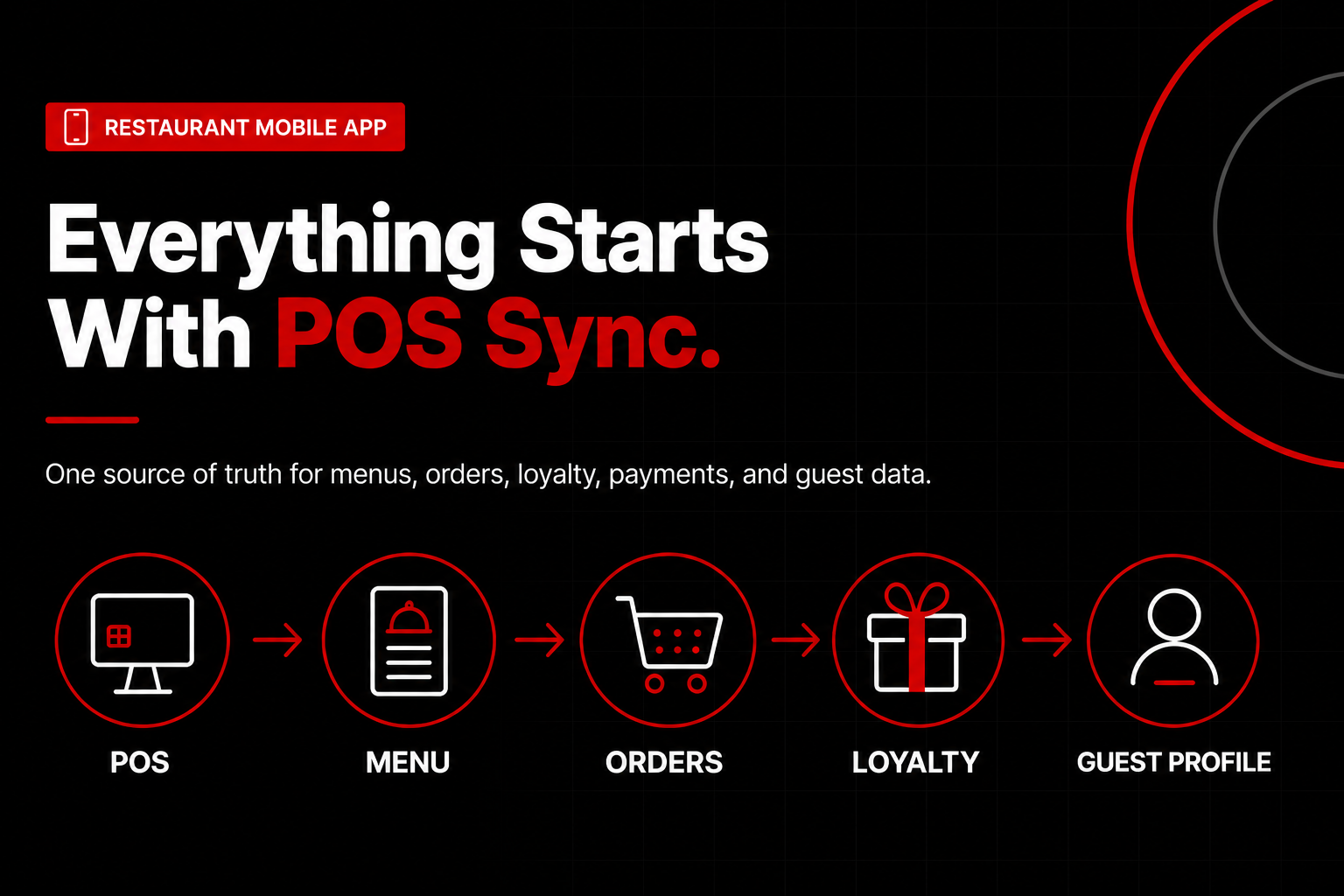
Step 1: Establish the POS as the single source of truth
Your POS is the authoritative database for menus, pricing, taxes, modifiers, and availability. A restaurant mobile app should never invent its own version of the menu—it should mirror POS data continuously. In a modern restaurant POS system online ordering setup, this sync happens via APIs that push updates within seconds, not hours.
In practical terms, this means menu pushes happen automatically when you 86 an item or adjust a price (no midnight app edits). Operators who centralize POS-to-app ownership reduce comped orders and staff confusion. Most multi-location brands now schedule weekly menu audits to keep sync clean, a shift from the manual updates common just a few years ago.
Step 2: Sync menus, modifiers, and availability in real time
Real-time sync is about more than prices—it’s about modifier logic. Every modifier group in the app must map to a POS ID, not a name. Names change. IDs don’t, and that distinction prevents silent errors that only show up during peak service.
We worked with a mid-size QSR group rolling out their first restaurant mobile app across 14 locations. Modifier mismatches caused 6–8% of mobile orders to be re-fired manually for a month. Once modifier logic was locked to POS IDs, errors dropped below 1% in two weeks and expo labor fell by ~20 hours per week chain-wide.
Step 3: Route digital orders directly into kitchen workflows
Ordering integration works when app orders flow into the POS like any other ticket. The kitchen shouldn’t care where an order came from—only that it’s accurate and timed correctly. This parity is why Toast, Square, and similar platforms emphasize native digital order ingestion.
This is where a restaurant POS system online ordering flow lives or dies. The app captures intent, but the POS controls routing, throttling, and prep timing. Orders are queued based on kitchen capacity rules, fired to the correct prep station, and held or delayed automatically during rushes so mobile demand doesn’t overwhelm on-premise guests.
You’ll want to configure prep timing and order pacing inside the POS, not the app layer. The POS enforces reality while the app stays flexible. Done right, mobile orders feel invisible to the line—no callouts, no special handling, no chaos.
Step 4: Create one shared guest profile across systems
A guest profile is the connective tissue between ordering, waitlists, and loyalty. Every action—order placed, table joined, reward earned—should write back to the same profile. This unified record is what allows personalization to scale beyond basic discounts.
Most modern stacks now tie guest profiles directly to POS check data and payment tokens. When identity, spend, and behavior live together, targeting stops being guesswork. Without that link, even the best-designed loyalty program underperforms.
Step 5: Tie waitlists to POS table status (with guardrails)
Waitlist integration works best when it listens to POS table status. A restaurant mobile app should add guests only when tables can realistically turn. This alignment cuts host workload and prevents the double-booking headaches common with disconnected systems.
We’ve seen no-show rates spike when guests join waitlists too early from home. Geofenced check-ins and timed confirmations add intentional friction. A 0.5-mile radius and a 10-minute tap-to-confirm window consistently improve table utilization.
Step 6: Write loyalty earn and burn directly into the POS
Loyalty is effective when points accrue and redeem at the POS, not in a silo. A simple 1 point per $1 spent model works because it’s transparent and auditable. When tied to POS checks, earn and burn happens automatically with no staff intervention.
Payment reconciliation matters here. Orders paid in-app must reconcile cleanly against POS batches, including tips, refunds, and partial redemptions. Operators who skip this step often discover 2–3% of monthly revenue sitting as untracked loyalty liability.
Step 7: Monitor integration failure points before guests feel them
Most integration failures aren’t dramatic—they’re quiet. Latency, partial syncs, and modifier drift erode trust order by order. Staff usually notice first, when they start double-checking tickets or questioning totals.
Here’s a quick checklist we use during audits:
Catching these early protects both labor and guest confidence. Left alone, they quietly undo the value of owning your own app.
Step 8: Evaluate POS ecosystems and constraints up front
Not all POS platforms expose the same APIs or sync frequency. Aldelo for restaurants, for example, offers deep menu and guest data access—but requires deliberate mapping upfront. If you’re considering this stack, read our breakdown on integrating a restaurant mobile app with Aldelo POS.
This approach works best for operators willing to maintain menu discipline. If modifiers change daily across locations, expect ongoing admin time. There’s no free lunch here—just fewer surprises when expectations are clear.
Step 9: Validate the end-to-end flow with real scenarios
Before launch, test like a guest. Place an order, join the waitlist, earn points, and redeem them. Do it during peak hours, not Tuesday at 2 p.m., so edge cases actually surface.
In our work at nabeeats.ai, we test rush-hour ordering, sold-out modifiers, and loyalty redemption on split checks. If it breaks there, it’ll break live. Fix it now, not in front of paying guests.
Step 10: Decide whether to own or outsource this stack
Once integration works, the strategic question surfaces. Do you own this data flow—or rent it from marketplaces? Owned apps preserve guest data and enable targeted outreach that compounds value over time.
Want help implementing this? See how Nabe Eats can streamline your restaurant marketing.
This technical foundation sets up the real decision ahead. Next, we’ll compare owning this stack versus relying on third-party marketplaces—and where each actually makes sense.
Owned restaurant mobile app vs third-party marketplaces: a comparison
An owned restaurant mobile app prioritizes guest data and lifetime value, while third-party marketplaces trade control for short-term discovery. That trade-off isn’t philosophical—it’s operational and financial. Once your POS, menus, guest profiles, and restaurant online waitlist are unified, the real question becomes where orders and guests should flow for the next five years, not just the next Friday night.
Before the table, here’s the framing we use with operators. Marketplaces like ChowNow, Toast TakeOut, and RestApp optimize for their own network economics, not your repeat visits. Your app optimizes for your margins, your data, your guest relationships, and increasingly, your front‑of‑house flow through owned waitlists and reservations (and yes, that difference compounds quietly over time).
Owned app vs marketplace platforms: side-by-side
DimensionOwned restaurant mobile appThird-party marketplacesGuest data ownershipYou own full profiles, order history, waitlist behavior, and visit frequencyPlatform owns data; limited export (including ChowNow and RestApp)Fees & commissionsProcessing fees only; no per-order commission0%–30% commissions or bundled SaaS fees (Toast TakeOut varies by plan)Average order value15%–25% higher AOV reported via direct channelsLower AOV due to price anchoring and comparison shoppingRepeat visit economicsLoyalty, personalization, and owned waitlists drive LTVWeak repeat signals outside the platform appDiscovery & reachRequires promotion and habit changeBuilt-in marketplace traffic and app-level SEOControl over experienceFull control of menu, pacing, upsells, and waitlist flowPlatform rules and UI constraintsWaitlist & table managementPOS-connected restaurant online waitlist with SMS/app-native notificationsBasic reservation or waitlist layers (often separate from ordering)Long-term ROIReported 25x–35x ROI on owned apps in 2026 benchmarksROI capped by fees, churn, and paid placementOperational flexibilityPOS-driven rules and integrationsLimited workflow customization
Now let’s unpack what actually matters behind those rows—because the table alone doesn’t tell you when each option makes sense.
Data ownership and guest access: where value really accumulates
Owned restaurant mobile apps create a direct data loop between the POS and the guest. That loop now extends beyond orders into check-ins, wait times, and table turns. Updated 2026 benchmarks show brands using first-party apps outperforming ChowNow- and Toast TakeOut–only setups on repeat rate and contribution margin within six months.
We’ve seen this play out with businesses we work with at nabeeats.ai. When guest profiles include visit timing and restaurant online waitlist behavior, targeting gets sharper. A fast-casual group used last-visit and wait-time tolerance data to trigger off‑peak incentives and saw a 17% repeat lift in eight weeks—without blanket discounts.
Marketplaces limit this. You see the order, not the full visit. Email access is partial, waitlist interactions live off-platform in tools like RestApp, and loyalty signals reset every time the platform promotes a competitor down the street.
Fees vs lifetime value: the math operators skip
Marketplace fees feel variable and painless—until you annualize them. A 20%–30% commission on a $40 order doesn’t just cost $8–$12 once; it suppresses future margin and loyalty. Over a year, that same guest might order 6–10 times, all taxed by the platform.
Owned apps flip that equation. You pay upfront build and maintenance costs, then keep contribution margin on every repeat order and visit. Even operators using Toast POS increasingly pair it with a branded app to replicate Toast TakeOut functionality without recurring per-order fees.
Here’s the contrarian part—marketplaces aren’t “expensive” if you only evaluate single orders. They’re expensive when you evaluate guest lifetime value across ordering and dine‑in visits. That’s the lens most operators never apply.
Discovery feels easier on marketplaces—until it doesn’t
Marketplaces win on day one. They already have traffic, search behavior, and credit cards on file. For new concepts, food trucks, or seasonal pop-ups, ChowNow and RestApp visibility can accelerate early demand.
But discovery rarely converts into loyalty. Guests remember the app they ordered or booked from, not the restaurant they ordered through. This mirrors what operators see in OpenTable-style SERPs, where the platform brand dominates recall.
One multi-location café group we advised saw total digital orders dip 4% in the first month after launching their app. Painful. By month three, after POS-triggered receipt prompts and app-only waitlist text updates, direct orders ended up 22% higher than pre-launch.
Operational control: the hidden differentiator
Owned apps integrate tightly with your workflows. Menu changes, modifiers, pacing rules, and restaurant online waitlist logic all live where managers already work—the POS. This replicates what Toast TakeOut offers, then extends it with deeper customization.
Marketplaces abstract those controls. You adapt your front‑of‑house flow to their constraints, not the other way around. For single-unit shops, that’s manageable; at scale, it quietly adds labor and error risk.
Honest caveat: ownership requires promotion and change management
Owned apps don’t promote themselves. You have to train staff, adjust signage, update receipts, and explain why joining your waitlist or ordering direct matters. 2026 rollout data shows the best-performing brands assign one internal owner and budget 3–5 hours per week for optimization.
This approach works best for restaurants with repeat traffic potential—fast casual, QSR, and neighborhood favorites. If you’re a high-AOV, occasion-driven fine dining concept, the app’s value skews toward controlled communication and owned reservations.
When each option actually makes sense
Use marketplaces when:
Prioritize an owned restaurant mobile app when:
Want help implementing this? See how Nabe Eats can streamline your restaurant marketing.
Once you decide ownership matters, the next challenge isn’t strategy—it’s execution. Up next, we’ll break down how to launch and roll out an owned app without operational chaos or staff burnout.
Launching a restaurant mobile app: step-by-step implementation plan
Launching a restaurant mobile app works best when you start with ordering and POS integration, stabilize operations, then layer in loyalty and analytics after the core flow proves reliable.
Want help implementing this? See how Nabe Eats can streamline your restaurant marketing.
Here’s the honest caveat—this approach works best for operators committed to ownership and change management; if you won’t promote the app or maintain menus, marketplaces may still make sense short-term. But if you follow this rollout, you’ll be ready to judge success beyond installs, shifting the conversation to repeat rate, contribution margin, and lifetime value—which is exactly where the next section goes.
The contrarian truth about restaurant mobile app ROI and loyalty
Restaurant mobile app ROI comes from repeat behavior and contribution margin, not app installs or discount volume. The operators who win treat their app like a margin system, not a marketing campaign—and that framing changes every decision you make next.
Problem: Chasing installs hides the real ROI math
Most restaurant mobile app launches start with the wrong scoreboard. Installs, push opens, and promo redemptions feel good—but they rarely correlate with lifetime value. According to LoyaltyLive’s 2026 data, restaurants using their own branded apps report up to 34x ROI and 15%–25% higher average orders versus third-party platforms, but only when repeat ordering and direct margin improve—not when discounts spike volume [dp_4].
We’ve seen this play out with operators who ran aggressive “$10 off your first app order” campaigns. Adoption jumped, but contribution margin fell once redemptions and promo-trained behavior kicked in (honestly, this is where most owners get burned). The app didn’t fail—the measurement did.
Approach: Reframe the app as a margin-and-loyalty system
A restaurant mobile app is a behavior engine, not a billboard. Its job is to reduce friction for reorders and reward the behaviors you actually want—frequency, add-ons, and direct channel preference. GitNexa’s 2026 guide shows the winning pattern clearly: ordering, payment, and loyalty happen in one flow, tightly connected to POS data [dp_1].
In our work at nabeeats.ai, we start by mapping three numbers before any campaign goes live: repeat rate, average order value, and contribution margin after rewards. If a promotion doesn’t move at least one of those without hurting the others, it doesn’t ship. Simple rule. Hard discipline.
Case detail: Why blanket discounts quietly kill LTV
Here’s a fast-casual example we see constantly. A brand launches a restaurant mobile app with points, push notifications, and weekly discounts across the menu. After eight weeks, repeat visits rise just 4%—barely noise—while food cost and redemption liability creep up [anec_3].
We changed one thing. Offers became POS-driven and behavior-specific: bowl buyers saw add-on prompts, drink skippers got beverage nudges, and lapsed users got time-bound reminders tied to their last order. Repeat visits jumped 17% in the same timeframe, with no margin erosion. Same app. Different logic.
Result: POS-driven loyalty outperforms generic rewards
POS-driven loyalty is loyalty that responds to what a guest actually does, not what you wish they’d do. Buildify recommends simple points-per-dollar models like 1 point per $1 spent, but the real lift comes from how you deploy those points [dp_5]. The POS is the referee—it knows items, frequency, and timing.
According to Toast benchmarking data, targeted offers tied to past orders convert 2–3x better than broad campaigns. That’s why generic “10% off your next visit” rewards underperform—they don’t change behavior, they subsidize it. Precision loyalty does the opposite.
Framework: The three loyalty rules that actually compound value
Use this checklist when configuring loyalty inside your restaurant mobile app:
Each rule reduces cognitive load for guests and operational drag for staff. Less choice, more clarity—that’s the compounding edge.
Honest caveat: High-AOV concepts play a different game
Not every restaurant benefits equally from frequency-driven loyalty. For $60–$100 AOV full-service concepts, incentives don’t create occasions—they cheapen them. We worked with a premium dining brand where app adoption looked healthy, yet 90-day lifetime value stayed flat [anec_5].
The pivot wasn’t discounts. It was personalization—wine releases, tasting menu previews, and priority booking alerts triggered by POS history. That shift drove a 12% lift in special-occasion bookings, where margin actually lives. Same platform, different outcome.
Result: Fewer features, better economics
More features usually reduce adoption, not increase it. Every extra tab adds friction, and POS data shows most guests use one primary function per visit [insight_1]. GitNexa and Flipdish both recommend launching with ordering first, then layering loyalty and analytics once behavior stabilizes [dp_10][dp_11].
We’ve seen operators overspend early—$75,000+ builds with AI recommendations—before proving reorder lift. Start simple, prove margin impact, then expand. That sequencing beats flashy launches every time.
Tooling note: POS integration makes or breaks ROI
All of this collapses without clean POS integration. Behavior-specific loyalty only works when item data, modifiers, and guest profiles sync perfectly. Platforms like Toast, Square, and Aldelo handle this well when configured correctly; sloppy mapping quietly burns labor and trust [anec_1].
If you’re evaluating vendors, ask how loyalty rules read POS data in real time—and how errors surface. Integrating a restaurant mobile app with Aldelo POS, for example, lets operators anchor loyalty and offers to a single source of truth rather than duct-taped exports.
Takeaway: Judge success by lifetime value, not hype
The contrarian truth is uncomfortable. A restaurant mobile app that doesn’t improve repeat behavior or margin is just expensive software. The upside is real—34x ROI doesn’t happen by accident—but only when loyalty design respects unit economics [dp_4].
As you think through ROI, a few practical questions usually come next. How long does payback take? What metrics matter month one versus month six? When should you skip loyalty entirely? That’s where we’ll go next—tight, operator-focused answers to the questions owners keep asking once the hype fades.
Frequently Asked Questions
How much does a restaurant mobile app really cost?
A restaurant mobile app typically costs less over 12 months than most owners expect once you factor in commission savings and repeat orders. Beyond build fees, plan for $150–$500 per month for hosting, updates, and support, based on benchmarks from Restolabs’ 2025 operator data. The real cost variable is POS depth—tight integrations with systems like Toast or Aldelo for Restaurants reduce manual labor and usually pay for themselves within 6–9 months.
Do small independent restaurants actually need a restaurant mobile app?
A restaurant mobile app makes sense for independents once you have repeat guests and steady off‑premise demand. In our work with single‑unit operators, concepts doing 25–40% of sales off‑premise saw 18–27% higher reorder rates after launching an owned app versus web ordering alone. If you’re under $1M in annual sales and mostly dine‑in, start simple—but don’t rule it out long term.
How long does POS integration take for a restaurant mobile app?
POS integration usually takes 2–6 weeks, depending on your POS and menu complexity. According to Restolabs implementation data, cloud POS systems like Toast, Square, and Aldelo for Restaurants integrate faster because menus, pricing, and modifiers sync automatically. The slowdown almost always comes from menu cleanup, not the tech itself (honestly, this is where most teams underestimate the work).
Will a restaurant mobile app replace third-party delivery apps?
A restaurant mobile app won’t fully replace third-party delivery, but it should reduce dependence on it. Operators we’ve worked with shifted 15–30% of repeat delivery orders from marketplaces to their owned app within six months by offering app‑only perks instead of discounts. Use DoorDash and Uber Eats for discovery, then migrate loyal guests to your restaurant mobile app where margins actually stick.
How do you measure success after launching a restaurant mobile app?
Restaurant mobile app success shows up in lifetime value, not installs. Track repeat purchase rate, average order value, and contribution margin by channel—Toast and Square both surface these metrics natively when integrations are set up correctly. If app users aren’t ordering 1.3–1.6× more often than non‑app guests by month six, something in the flow needs fixing.
What’s the smartest next step before choosing a restaurant mobile app platform?
The smartest next step is mapping one complete guest journey—from first order to third visit—inside your restaurant mobile app. Our team at nabeeats.ai usually starts with a 30‑minute POS and data audit to see where loyalty, ordering, and waitlists actually break down (and yes, this works for multi‑unit groups too). Once you see the gaps clearly, choosing the right platform becomes obvious—and far less risky.
Take Action on Your Restaurant Mobile App Strategy
You didn’t read this to build another shiny feature—you’re here to fix fragmented guest experiences, and a restaurant mobile app only works when it becomes your owned experience engine.
Start with a simple POS and data audit, then build only what compounds lifetime value—our team at nabeeats.ai can help you pressure‑test your stack before you spend a dollar.
A restaurant mobile app isn’t a launch—it’s a system. The real question is whether yours will still be driving margin and loyalty a year from now.
.png)

.png)


