.png)


75% of food orders now flow through digital channels, yet most operators don’t actually own the guests behind those orders. That’s the trap—we’ve seen restaurants invest in a restaurant ordering platform expecting sales growth, only to realize they rented demand instead of building an asset.
According to the National Restaurant Association’s 2024 Restaurant Technology Landscape Report, adoption is up, but ROI often disappoints because marketplaces keep the data and skim 15–35% per order. In our work with restaurants at nabeeats.ai, this plays out constantly: third-party apps spike volume short term, then quietly cap long-term growth (spoiler: commissions aren’t the real cost).
This guide reframes the decision. You’ll learn how to choose a restaurant ordering platform that drives direct sales, captures guest data, and supports social commerce—not just another checkout button. We’ll break down what actually works, where most advice falls apart, and how to build the right foundation so digital growth doesn’t stall after the first bump.
Why online ordering growth breaks down for most restaurants
Most restaurants struggle with online ordering because high commissions, anonymous guests, and disconnected systems prevent repeatable, profitable growth. Orders increase, but margins thin out, guest data disappears, and teams feel more friction—not less. We’ve seen this pattern across independents, fast casual chains, and even multi-unit brands rolling out their first restaurant ordering platform.
High commission fees quietly erase the upside
Marketplace-driven growth looks good on a sales report and bad on a P&L. 72% of restaurants say high commission fees—typically 15% to 35% per order—are their biggest delivery challenge. According to Deliverect’s 2025 US report, that cost compounds as volume grows, not shrinks, which flips the usual “scale fixes everything” logic on its head.
Here’s the contrarian part. Third-party delivery isn’t your growth engine; it’s a tax on demand you already created. We’ve seen operators celebrate a 20% jump in digital orders while net profit stayed flat because commissions absorbed the gain (painful, but common).
A quick reality check helps. Run this math on your own numbers:
That’s $12,768 in monthly fees before marketing or labor. Growth without margin isn’t growth—it’s churn disguised as traction.
Anonymous guests kill retention before it starts
Volume doesn’t equal loyalty if you can’t identify who’s ordering. 60% of restaurant revenue comes from just 20% of guests. That insight comes from Olo’s analysis of 100 million guest records, and it explains why anonymous orders are so destructive.
Here’s the issue. Most marketplace orders arrive without usable guest data, which means no remarketing, no lifecycle messaging, and no way to nudge a second order. You’re stuck paying again to reacquire the same person next week.
In our work with operators at nabeeats.ai, this shows up fast. A fast-casual brand saw digital sales climb month over month, yet repeat order rate stalled under 18% because 70% of orders came through channels they couldn’t attribute to real people.
The fix isn’t theoretical. Restaurants using integrated ordering and unified payments can match nearly 100% of orders to guest profiles. Olo reports close to a full match rate when ordering, payments, and guest data live in one system—no guesswork required.
Disconnected systems add labor instead of saving it
Online ordering should reduce chaos. Too often, it does the opposite. Operators underestimate the labor cost of disconnected ordering systems, and that cost shows up during the dinner rush.
According to our internal benchmarks, managers lose 30–45 minutes per shift toggling tablets, re-entering orders, or fixing modifier errors when platforms don’t sync cleanly. Multiply that by five nights a week, and you’re burning hours—not saving them.
We’ve seen this play out with a $90k/month bowl concept. They chose the cheapest tool, but it didn’t mirror their POS modifier logic. Within three weeks, ticket times stretched by 5–7 minutes, and Google ratings dipped 9% after repeated order mistakes. Cheap software got expensive fast.
What to pressure-test before you sign:
Operational fit beats feature lists. Every time.
Digital ordering alone doesn’t create demand
Online ordering is infrastructure, not traffic. A restaurant ordering platform won’t drive growth if you don’t control where demand flows and how checkout converts. This is the caveat most vendors skip.
According to SpotOn, 66% of adults are more likely to order takeout when online ordering is available, but availability doesn’t guarantee discovery or conversion. If your Google profile, Instagram bio, and email links point to a marketplace, you’re exporting demand you already own.
We’ve watched a 22-unit burger group reroute only owned channels—Google, email, SMS—to their direct ordering site. Within 90 days, 27% of prior third-party volume shifted to direct orders without discounts. Same guests. Different destination.
This matters even more for social commerce. Instagram and TikTok traffic converts best when checkout is fast, branded, and mobile-native (and yes, food trucks benefit too). Marketplaces weren’t built for that flow.
The real reason growth stalls
These failures share a root cause. Most operators evaluate platforms on features and fees instead of data ownership, operational fit, and traffic control. The result feels like an online ordering problem, but it’s actually a decision framework problem.
Digital tools work when they align with the overall strategy for my restaurants and support powering an online restaurant business you control—not rent. That’s the shift.
Want help implementing this? See how Nabe Eats can streamline your restaurant marketing.
Up next, we’ll break down how to evaluate a restaurant ordering platform the right way—so growth compounds instead of stalling after the first spike.
Restaurant ordering platform vs third-party marketplaces: the real cost and control trade-offs
A restaurant ordering platform gives you data ownership and margin control, while third-party marketplaces trade both for short-term visibility at a higher long-term cost. That trade-off is rarely explained clearly, even though it shapes profit, retention, and how fast you can actually grow.
Here’s the clean comparison most vendors dodge—numbers first, emotions second.
Side-by-side: cost, control, and growth impact
DimensionThird-party marketplacesRestaurant ordering platformCore cost model15%–35% commission per orderFlat monthly subscription + processingTotal cost visibilityVariable and unpredictableFixed and forecastableGuest data accessLimited, aggregated, or noneFull access at order levelData export & portabilityNot allowed or restrictedCSV/API export, portable if you switchMarketing controlPlatform-owned ads and promosYou control email, SMS, remarketingConversion optimizationMarketplace decides UXYou test menus, upsells, checkoutBest use caseNew visibility, incremental demandRetention, LTV, owned growth
72% of restaurants say high commission fees (15%–35%) are their biggest delivery challenge. According to Deliverect’s Top Food Delivery Statistics 2025, those fees compound as volume grows, which quietly caps margin even when sales rise. That’s the hidden ceiling operators hit—revenue up, profit flat.
Now flip the lens.
A restaurant ordering platform is software you pay for whether you sell one order or one thousand. Subscriptions range from a few hundred dollars per month upward, plus payment processing. That fixed cost changes the math, especially early on (and yes, this is where the contrarian insight matters).
What “guest data ownership” actually means
Guest data ownership is your ability to access, export, and reuse identifiable order data without permission from a third party. If you can’t download emails, phone numbers, and order history, you don’t own it—period.
In our work with restaurants at nabeeats.ai, we look for three non-negotiables:
Platforms like Olo prove why this matters. According to Olo’s 2024 guest data analysis, restaurants using an integrated ordering and payment system achieve close to a 100% match rate between payments and guest profiles, eliminating anonymous orders entirely. That’s what unlocks retention—not just “having emails.”
Marketplaces don’t offer this. At best, you get aggregated insights. No names. No remarketing. No second-order strategy.
The contrarian truth most vendors won’t say
Direct platforms can be more expensive at low volume. Full stop.
This is the part most sales decks skip. If you’re doing fewer than ~150–200 online orders per month, a $300–$500 subscription can cost more than marketplace commissions. The math doesn’t work yet, and pretending otherwise hurts trust.
We’ve seen this play out with single-location fast casuals launching direct ordering too early. Orders stayed flat for 30 days, and the owner questioned the decision. The turnaround only happened once conversion tools—menu photos, upsells, SMS remarketing—were activated, pushing volume past the break-even point (this is where most owners drop the ball).
The upside is real, but only after you cross a volume threshold or actively drive traffic. If you won’t market your owned channel, marketplaces may be cheaper—temporarily.
The hybrid model most operators actually win with
A hybrid model is using marketplaces for discovery while routing owned demand to your restaurant ordering platform. This isn’t fence-sitting—it’s strategy.
According to Deliverect and Contrary Research, global food delivery revenue will hit $1.40 trillion in 2025. Visibility still matters. Quitting marketplaces entirely rarely makes sense, especially for new locations.
We’ve seen operators win by doing three things:
One multi-unit burger group we worked with shifted 27% of prior marketplace volume to direct in 90 days without discounts—just traffic control and data capture. That’s margin without sacrificing reach.
This hybrid approach aligns with the overall strategy for my restaurants, where owned channels compound value while rented channels stay tactical.
How this choice affects long-term growth
Marketplaces optimize for their growth, not yours. A restaurant ordering platform optimizes for your repeat rate, AOV, and lifetime value—if you use it correctly.
75% of U.S. food orders now flow through digital channels, according to Contrary Research’s 2025 data. The question isn’t digital vs physical anymore—it’s owned vs rented demand.
If you plan to build an email list, run SMS, test menus, or power an online restaurant business, ownership matters. If you just need incremental orders during slow periods, marketplaces still have a role.
Want help implementing this? See how Nabe Eats can streamline your restaurant marketing.
Up next, we’ll get practical—how to evaluate a restaurant ordering platform based on fit, not marketing claims, so your tech stack actually supports growth instead of slowing it down.
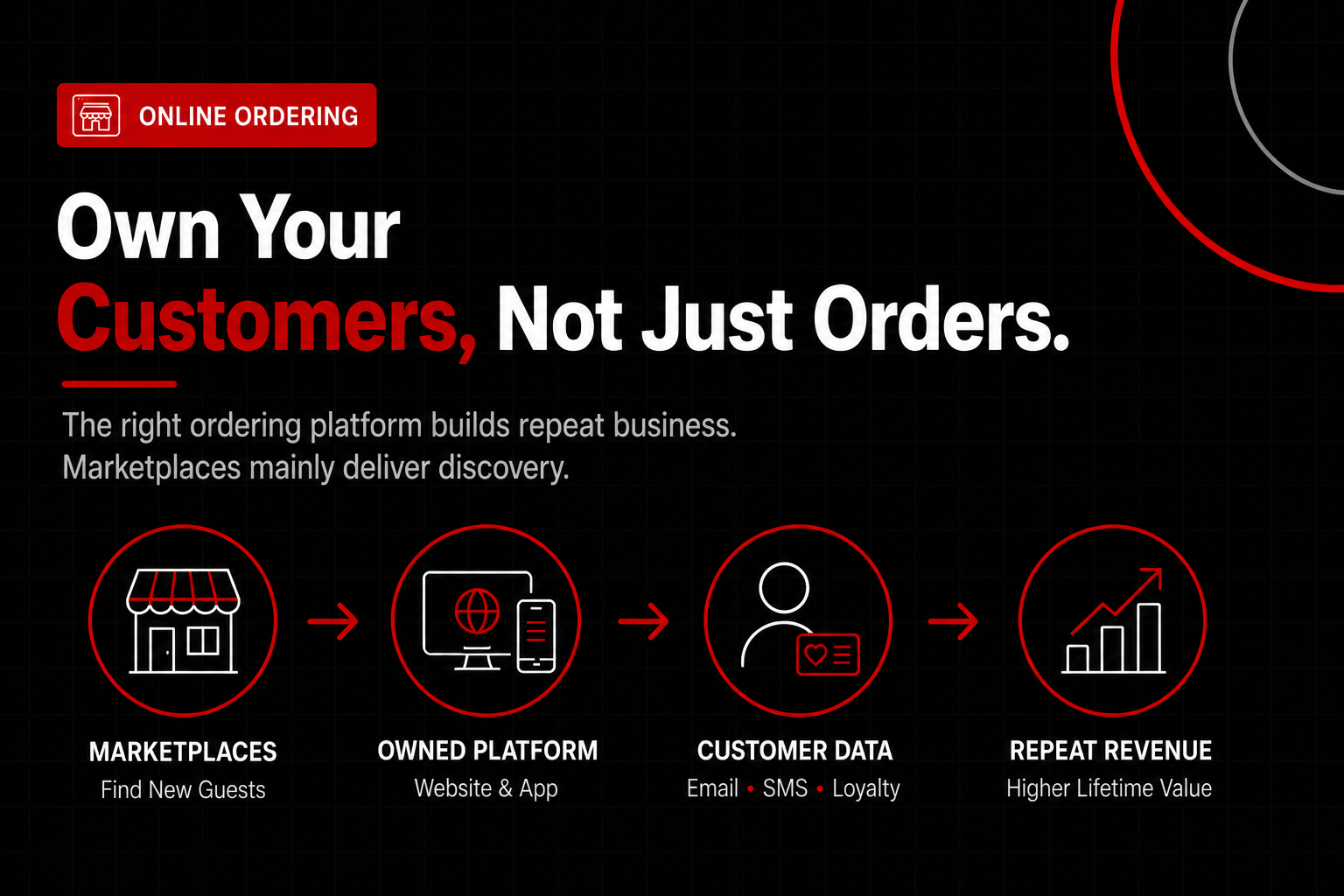
How to choose a restaurant ordering platform for direct sales and long-term growth
The best restaurant ordering platform is chosen by evaluating POS fit, checkout conversion, guest data integration, and traffic control—not by price alone. That framing matters because the wrong system quietly caps your online restaurant business before demand even shows up. We’ve seen operators obsess over monthly fees while missing the mechanics that actually drive repeat orders. This is the step-by-step filter our team uses at nabeeats.ai when helping restaurants make the call.
Step 1: Verify POS and kitchen workflow compatibility with a live menu sync demo
Start by proving the restaurant ordering platform mirrors your real POS and kitchen logic, not a generic demo environment. A platform that can’t live-sync modifiers, prep times, and out-of-stock logic will cost you 4–6 extra hours per week fixing errors (id=cons_1). Demand a live menu sync using your actual Toast, Square, or Clover data—no sandbox, no screenshots.
We’ve seen this play out with fast-casual clients who skipped this step and paid for it immediately. One bowl concept chose a cheaper tool that didn’t support nested modifiers; within three weeks, dinner tickets slowed by 5–7 minutes and Google ratings dipped 9% (anec_2). Operational fit beats feature lists—every time.
Action check: Ask vendors to run a real order through your POS, then watch it print on the line (yes, during a mock rush).
Step 2: Evaluate checkout conversion, upsells, and loyalty enrollment friction
Next, pressure-test how the platform converts traffic into completed orders. Checkout design is where 10–20% of revenue quietly appears or disappears, and most vendors gloss over it. According to Owner.com deployment data, checkout upgrades drove a 14% lift in online conversion rates (id=dp_4), which translated to $524 in extra monthly sales for a single-location operator (id=dp_5).
Loyalty enrollment belongs inside checkout, not on a poster by the register. When friction is removed, 82% of guests opt into loyalty during checkout—validated by unPLUG’s Luna Grill data (id=dp_3). We’ve seen fast-casual brands replace “download the app” signage with OTP login at checkout and watch enrollment spike in weeks, not quarters.
Action check: Place a test order yourself and time the checkout. If it takes more than 45 seconds or forces an account before payment, conversion will suffer (honestly, this is where most platforms stumble).
Step 3: Confirm unified guest data and payments to eliminate anonymous orders
Guest data ownership only matters if payments and profiles actually match. Restaurants can achieve close to a 100% match rate between payments and guest profiles when ordering and payments are unified (id=dp_2). Olo demonstrated this by pairing its Guest Data Platform with Olo Pay, eliminating anonymous direct orders entirely.
In our work with multi-unit operators, this is the inflection point. Anonymous orders kill remarketing, frequency tracking, and lifetime value modeling—full stop. unPLUG’s 2026 first-party data guide makes it clear: first-party data means you can attribute, activate, and export guest records whenever you want (id=src_4).
There’s a caveat. This approach works best if you’re willing to use the data, not just collect it. If your team won’t send SMS or email campaigns, prioritize simplicity over sophistication (cons_3).
Action check: Ask where guest data lives, how it’s exported, and what happens if you leave the platform.
Step 4: Assess built-in tools for social commerce and traffic control from Google and Instagram
Finally, evaluate how the platform helps you control demand. Direct ordering growth is driven more by traffic control than by discounts (insight_3). According to Contrary Research, 85% of diners look up a menu before ordering (id=dp_6), and most start on Google or Instagram.
The platform should natively support Google Business Profile order links, Instagram bio ordering, and social storefronts—without routing guests through third-party apps. We worked with a Midwest burger group that redirected Google and email traffic to their owned ordering flow while keeping delivery apps live; within 90 days, 27% of marketplace volume shifted to direct with zero discounts (anec_4).
This is where social commerce gets real (and yes, it works for food trucks too). If the platform can’t tell you where orders originated, you’re flying blind.
Action check: Map every public link—Google, Instagram, QR codes—to your owned ordering URL.
Put the framework together before you compare prices
Here’s the practical order of operations—use it as a checklist before signing anything:
Only after these pass should you compare subscription costs. Lower commission doesn’t always mean higher profit (insight_2), especially if conversion slips by 2–3%.
Want help implementing this? See how Nabe Eats can streamline your restaurant marketing.
If you’re aligning this decision with the bigger picture, connect these steps to powering an online restaurant business so ordering supports retention, not just transactions. Up next, we’ll pressure-test this framework against real restaurant scenarios—what works for fine dining, fast casual, and multi-unit groups, and where the trade-offs actually show up.
What actually works: real results from restaurants using direct ordering platforms
Restaurants see the best results from direct ordering when platforms improve conversion, upsells, and repeat behavior—not just reduce commissions. The throughline across winning operators is simple: they treat their restaurant ordering platform as a sales engine, not a cost line. We’ve seen this play out with fast casual, independents, and multi-unit groups that stopped chasing “cheaper” tech and started optimizing how guests actually order.
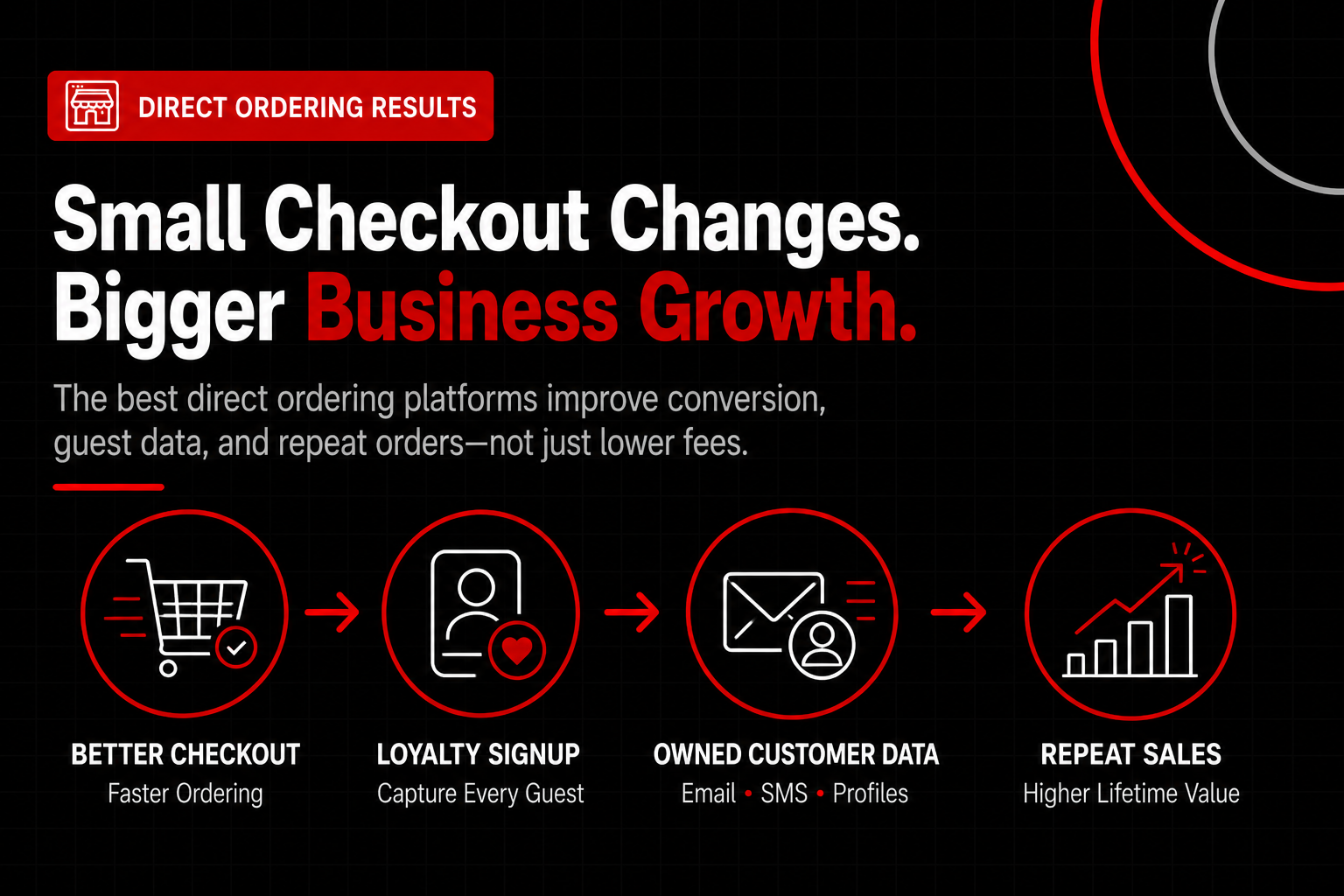
Case 1: Luna Grill turned checkout into a loyalty engine
Luna Grill faced a common fast-casual problem—plenty of digital traffic, but weak repeat behavior. The issue wasn’t demand; it was friction at checkout. Instead of pushing app downloads with in-store signage, they embedded loyalty enrollment directly into the ordering flow using OTP login (no passwords, no post-purchase steps).
When friction disappears, guests opt in. According to unPLUG deployment data, Luna Grill hit an 82% add-to-cart conversion for loyalty enrollment once enrollment lived inside checkout (id=dp_3). That’s not a vanity metric; it meant eight out of ten direct online orders immediately became attributable, marketable guests.
Here’s the actionable takeaway. If your platform treats loyalty as a separate destination, you’re leaving data on the table. Prioritize a restaurant ordering platform that captures phone or email at the moment of purchase—because that’s when intent peaks (and yes, this works for food trucks too).
Case 2: An independent restaurant earned $524 more per month—without new traffic
A single-location independent adopted Owner.com’s commission-free ordering with a built-in website. Traffic stayed flat. Marketing spend stayed flat. What changed was conversion. After Owner rolled out its 2025 checkout upgrade, the restaurant averaged $524 in additional monthly sales, exceeding the platform’s subscription cost (id=dp_5).
This wasn’t about saving 15–30% in commissions. Owner’s own data shows a 14% improvement in online ordering conversion rates tied directly to checkout UX changes (id=dp_4). Higher completion rates and clearer upsells drove the lift—not discounts or promos.
In our work with operators, this is where buyers misjudge ROI. A cheaper tool that converts 2–3% worse costs you more than a paid platform that keeps guests moving. Before comparing prices, ask vendors how often they ship conversion upgrades—and whether you benefit automatically.
Case 3: Multi-unit brands shifted demand off marketplaces—no discounts required
A Midwest burger group with multiple locations leaned heavily on third-party delivery. They didn’t quit marketplaces. They stopped feeding them owned demand. Google Business Profile links, email campaigns, and Instagram bios all routed to the brand’s direct ordering platform.
The result surprised even the operators. Within 90 days, 27% of prior third-party volume shifted to direct online orders without a single promo code (id=anec_4). No margin erosion. No guest backlash. Just better traffic control.
Here’s the lesson most competitors gloss over. Direct ordering growth is driven more by traffic routing than by incentives. If your restaurant ordering platform integrates cleanly with Google and social commerce, you can rebalance demand quietly—while marketplaces keep doing what they’re good at: discovery.
The ROI insight most operators miss
Conversion is revenue. Commission savings are secondary. A platform that improves checkout completion, increases average order value, and captures guest data will outperform a “cheap” tool every time.
60% of restaurant revenue comes from just 20% of guests. Olo’s analysis of 100 million guest records proves repeat behavior—not first orders—drives restaurant growth (id=dp_1). That only works when orders attach to real profiles, which requires integrated ordering and payments.
We’ve also seen the limits. This approach works best once you have baseline online volume. If you’re doing fewer than 100 digital orders per month, the fixed cost of a robust platform may outpace gains—start simple, then upgrade when conversion improvements can compound (honestly, patience here pays off).
What these cases have in common
Across brands, concepts, and sizes, the winning pattern repeats. The platform mattered less than how it was deployed. Operators focused on checkout design, data capture, and traffic control—not feature checklists.
If you want to pressure-test your own setup, audit these three areas first:
Want help implementing this? See how Nabe Eats can streamline your restaurant marketing.
These results don’t live in isolation. They only compound when ordering fits the overall strategy for my restaurants, tying menu, marketing, and operations into one system instead of scattered tools.
Up next, we’ll tackle the questions operators ask right before signing—pricing fears, migration headaches, and whether a restaurant ordering platform really fits your concept or scale.
Frequently Asked Questions
Is a restaurant ordering platform worth it for small or low-volume restaurants?
Yes, a restaurant ordering platform makes sense even for low-volume restaurants when it replaces marketplace fees with owned repeat business. According to the NRA 2024 Off-Premises Report, restaurants keeping orders direct save 15–30% per order in commissions, which matters more when margins are tight. We’ve seen food trucks and sub-100-order-per-week concepts break even within 60–90 days by converting just 20–30 loyal guests to direct ordering. For a growing online restaurant business, ownership beats scale early.
How much guest data do restaurants actually own and control with a restaurant ordering platform?
With a true restaurant ordering platform, you typically own 80–100% of guest data collected through direct orders. Deliverect’s 2023 platform benchmarks show that marketplace orders share limited guest data, often just a masked email or none at all, while direct platforms sync names, emails, order history, and opt-ins to your CRM. That data fuels email, SMS, and loyalty—things you can’t reliably do with anonymous marketplace guests. Control here directly impacts lifetime value.
Can third-party delivery still fit into a direct ordering strategy?
Yes, third-party delivery fits best as a fulfillment layer, not the primary sales channel. Olo’s 2024 Digital Ordering Report found restaurants using marketplaces for delivery but driving demand to direct ordering saw 12–18% higher repeat rates than marketplace-only operators. The practical move: route direct orders to DoorDash Drive or Uber Direct while keeping the guest relationship in your system (and yes, this works for multi-unit brands too).
How long does it take to implement a restaurant ordering platform?
Most restaurant ordering platform implementations take 2–6 weeks depending on menu complexity and POS setup. In our work with operators using Toast POS or Square, single-location restaurants often go live in under 21 days, while multi-unit brands need closer to 45 days for menu mapping and testing. The upside is speed to value—direct orders usually start converting within the first week post-launch. Delays usually come from menu cleanup, not technology.
How much does a restaurant ordering platform cost compared to marketplaces?
A restaurant ordering platform typically costs a flat monthly fee plus 2–4% processing, compared to 15–30% commissions on marketplaces. The NRA estimates the average marketplace order costs restaurants $6–$8 more per ticket once fees and promos stack up. That delta compounds fast as your online restaurant business grows. Flat pricing gives you predictability, which operators consistently underestimate.
What role does social commerce play in restaurant ordering today?
Social commerce now drives real, trackable orders when it connects directly to your restaurant ordering platform. According to Olo data from 2024, restaurants linking Instagram and Google ordering saw 8–12% of direct orders originate from social or branded search rather than third-party apps. The limitation: it works best if your checkout is mobile-fast and friction-light—otherwise traffic leaks. If you want help mapping this to your concept, tools like Nabe Eats can help streamline the process without ripping out your existing systems.
Choose Your Restaurant Ordering Platform with Growth in Mind
You don’t need more online orders—you need a restaurant ordering platform that lets you own the guest, control demand, and compound growth over time (that was the promise from the start).
We’ve seen this play out with restaurants across fast casual and multi-unit groups: direct ordering only works when data, conversion, and traffic control live in the same system. Marketplaces still make sense for incremental reach, but relying on them for growth caps your upside (and margins).
Start by mapping your ordering goals to the metrics that matter—then pressure-test your restaurant ordering platform against that plan. If you want a practical second opinion, explore how Nabe Eats supports operators building and powering an online restaurant business without giving up ownership.
If 75% of orders are already digital, the real question is simple: who owns the relationship when the order comes in?
.png)


.png)


