.png)


Ever find yourself staring at the clock at 12:07 p.m., scrolling reviews, and hoping you won’t regret your choice? That daily scramble for a solid restaurants lunch hits office workers between meetings, travelers on tight itineraries, and weekday diners who just want something fast and satisfying.
Lunch decisions feel rushed because they are—but they still matter. A heavy, slow meal can drain your afternoon energy, while a smart choice can boost focus and productivity. Data consistently shows that balanced midday meals improve alertness and reduce the 3 p.m. slump, which means where you eat directly affects how the rest of your day goes.
This isn’t another list of places you’ll forget. It’s an intent-based guide that shows you how to evaluate lunch spots anywhere, so you can balance speed, quality, and value with confidence. To do that, you first need to understand what actually makes a lunch restaurant good.
What Actually Makes a Great Restaurants Lunch Experience
This guide is about evaluating, not guessing, so it’s time to define what “good” means at midday. A great restaurants lunch experience follows different rules than dinner, even when the food comes from the same kitchen. Lunch success is measured less by ambiance and more by whether you can eat well, on time, without regret.
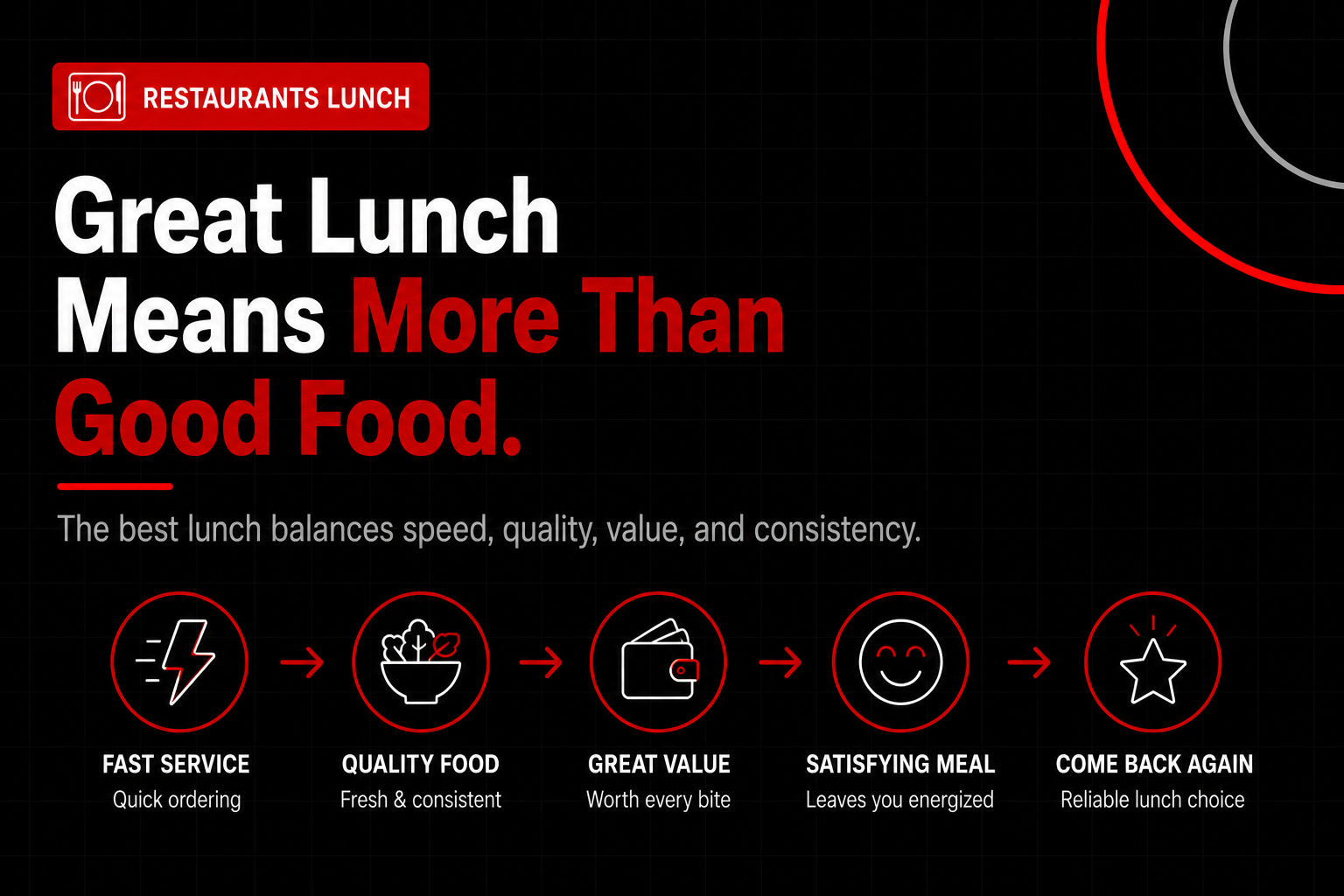
Lunch operates under tight constraints. The U.S. Bureau of Labor Statistics reports that most workers have a 30-minute lunch break, including travel time. A restaurant that shines at 7 p.m. can fail at noon if it can’t move fast, stay consistent, and deliver value without friction.
Understanding this difference is the foundation for choosing better restaurants lunch options anywhere you go.
Why lunch has different success metrics than dinner
Dinner is about experience. Lunch is about execution. At noon, you’re optimizing for speed, predictability, and satisfaction per minute, not a memorable night out.
You care less about cocktails and lighting and more about whether food arrives quickly, tastes consistent, and lets you leave without delay. A lunch restaurant that understands this designs operations around throughput, not theatrics.
This is why the same restaurant can feel amazing at dinner and frustrating at lunch. The menu may be identical, but the system often isn’t built for midday demand.
Speed factors: ordering efficiency, kitchen throughput, and check turnaround
Speed is the first non-negotiable in any restaurants lunch decision, and it goes beyond how fast food leaves the kitchen.
Ordering efficiency is the first signal. Lunch-friendly restaurants reduce decision friction with smaller menus, clear combos, or visible specials. If you can’t decide within a minute of opening the menu, the restaurant isn’t designed for lunch.
Kitchen throughput is the second factor. Strong lunch kitchens batch prep ingredients, rely on repeatable builds, and avoid dishes requiring long à la minute cooking. That’s why bowls, sandwiches, stir-fries, and slice-based pizza dominate lunch hours.
Check turnaround matters more than most people realize. Waiting five minutes to pay can derail your schedule. Successful restaurants lunch spots use counter ordering, QR payments, or bring the check with the food. That’s not cutting corners; it’s respecting time.
As a practical rule, if a restaurant can’t seat you, feed you, and close the check within 30–35 minutes, it’s a risky lunch choice unless you have flexibility.
Quality signals: menu focus, ingredient sourcing, and consistency
Speed alone doesn’t make a great lunch. Quality still matters, but it shows up differently at midday.
Menu focus is the clearest signal. Restaurants that try to do everything at lunch usually do nothing well. Strong restaurants lunch performers limit their menu to dishes they can execute quickly and repeatedly without decline.
Ingredient sourcing matters more in simpler dishes. Short menus expose quality. A turkey sandwich lives or dies by bread, meat, and produce. Ingredients don’t need to be premium, but they must hold up under volume.
Consistency is the quiet hero of lunch quality. You return because it worked before. If portions, seasoning, or prep change day to day, trust erodes. This consistency explains why chains dominate lunch, though independents with tight processes can compete.
Value beyond price: portion size, lunch specials, and satisfaction
Value at lunch isn’t just spending less. It’s what you get for what you spend.
Portion size matters in context. A great restaurants lunch leaves you full but functional. Oversized plates that slow you down all afternoon are as bad as meals that leave you hungry at 2 p.m.
Lunch specials are another strong value signal when done right. A smart lunch special means the kitchen has optimized that dish for speed and margin. You benefit from lower prices and faster service; the restaurant benefits from volume.
Satisfaction is the final metric. Ask whether the lunch solved your problem. If you paid $14, ate in 25 minutes, and felt energized instead of rushed or disappointed, that’s high value.
How these criteria apply across cuisines and settings
The good news is these rules work almost everywhere.
At a fast-casual Mediterranean spot, speed comes from assembly-line ordering, quality from fresh prep, and value from filling proteins and grains. At a sushi lunch counter, speed comes from prepped rolls, quality shows in rice consistency and fish handling, and value appears in lunch sets.
Even full-service restaurants can deliver a strong restaurants lunch if they adjust their system. A shortened menu, dedicated lunch staff, and preset pricing can turn a slow dining room into an efficient midday option.
Context changes, but the criteria don’t. Whether you’re downtown, in an airport, or on a small-town main street, great lunch spots respect your time, deliver consistent food, and leave you feeling like you made a smart choice.
Once you understand these criteria, the next step is applying them to your lunch intent—whether you need maximum speed, a working lunch space, or a satisfying break. That’s when choosing the right restaurants lunch option becomes automatic instead of stressful.
Choosing Restaurants Lunch Based on Your Midday Intent
Once you stop treating lunch as a generic problem, choosing restaurants lunch options gets easier. The key shift is moving from “What’s nearby?” to “What do I need from this meal right now?” Your intent—how you plan to use that 30 to 60 minutes—should drive the decision.
Intent-based decision making beats generic searching because it filters options fast. Instead of scrolling through dozens of menus, you eliminate places that don’t fit your goal. That’s how lunch goes from a time drain to a predictable win.
Research supports this. According to Toast’s restaurant trends data, weekday lunch diners care most about speed (62%), followed by price (54%) and environment (41%). Those priorities shift depending on whether you’re eating alone, with coworkers, or hosting a client. The best restaurants lunch choice changes with context.
Below are the most common midday scenarios and the traits that matter for each.
Solo work lunches: optimize for control and speed.
If you’re eating alone, lunch often doubles as a mental reset or a chance to catch up on email. The best restaurants lunch spots for solo diners share three traits: predictable service times, flexible seating, and low friction.
Counter ordering, digital menus, and fast-casual formats remove the wait-for-a-server bottleneck. Data from Square shows counter-service lunches average 18–22 minutes faster than full-service meals. That time savings matters when your calendar is tight.
Noise level is critical. You want moderate background sound—not silent, but not loud enough to break concentration. Cafés with spaced seating, window bars, or communal tables work well because you won’t feel rushed or awkward.
Budget discipline matters here too. Solo lunches are where you should stay closest to your daily spend target. If your ideal range is $12–$15, don’t stretch it unless the time savings is real. A small premium is only worth it if it reliably saves meaningful minutes.
Coworker lunches: balance speed with social flow.
Group lunches introduce coordination costs. The best restaurants lunch choices for coworkers reduce decision friction and simplify ordering for multiple people.
Menus with clear categories, lunch combos, or prix-fixe options shine here. They limit indecision and keep ordering under five minutes. A Cornell hospitality study found group meals run 25% longer when menus are overly complex, and that time usually comes out of your break.
Seating layout matters more than cuisine. Look for booths, long tables, or flexible seating that can handle four to six people without rearranging the room. Tight two-top layouts slow everything down.
Noise tolerance can be higher for coworker lunches. Slightly louder environments can make conversation feel relaxed, but avoid blaring music or echo-heavy rooms that force everyone to shout.
From a budget perspective, value perception matters. A $16 lunch feels expensive if portions are small or sides cost extra. Restaurants lunch spots that bundle an entrée, side, and drink often win with teams because no one feels overcharged.
Client-facing lunches: prioritize comfort, consistency, and service.
When lunch is part of a professional relationship, your intent changes. The best restaurants lunch options minimize risk. You’re not trying to impress with novelty; you’re trying to create a smooth, comfortable experience.
Full-service restaurants with experienced staff are usually safest. You want clear pacing—menus delivered quickly, orders taken promptly, and food arriving together. OpenTable data shows client lunches rated “excellent” on service were 40% more likely to lead to repeat meetings.
Noise level should be low enough to talk without leaning in. Private booths, padded seating, and basic acoustic control matter more than décor. Avoid trendy spots where lunch crowds spike unpredictably.
Budget rules shift here. Spending 20–30% more than your personal lunch norm is reasonable if it supports the relationship. Consistency matters more than price. A reliable $25 lunch beats a risky $40 one.
Use a quick intent-based framework before you choose.
To make this repeatable, run through a simple five-question check before picking a spot:
If a restaurant fails two or more checks, move on. This framework cuts decision time and keeps you aligned with your needs, not just cravings.
The biggest mistake people make with restaurants lunch decisions is ignoring intent until they’re seated. By then, you’re stuck with slow service, the wrong environment, or a bill that doesn’t match the value.
Once you build the habit of matching lunch spots to your midday purpose, you can apply the same thinking anywhere. Next, we’ll look at using this intent-based approach in real locations, whether you’re in a familiar office district or navigating an unfamiliar city.
Applying the System Anywhere: From Local Favorites to New Cities
Once you shift from “What sounds good?” to “What fits my lunch intent right now?”, the process becomes portable. The same system works whether you’re eating two blocks from your office or opening Google Maps in a city you’ve never visited. The key is knowing which signals matter and spotting them quickly.
This is where restaurant lunch choices stop feeling random and start feeling repeatable. You’re not hunting for the single “best” place. You’re scanning for lunch-specific clues that show a restaurant can deliver under midday constraints.
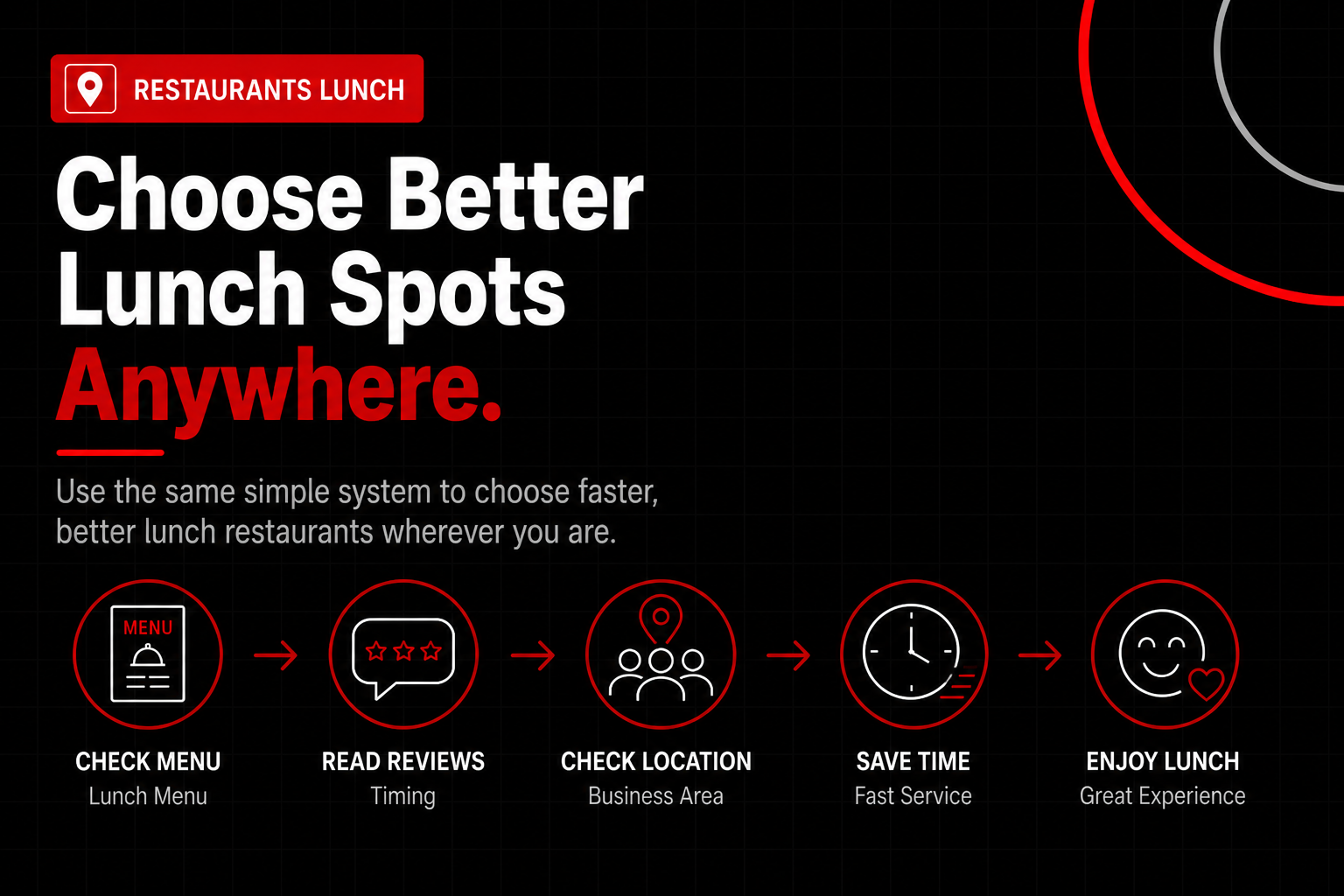
Start with the menu, not the rating. When time is limited, the menu reveals more than a 4.6-star average. Look for lunch combos, prix fixe options, or a clearly marked lunch section. Restaurants that move volume at noon streamline offerings, reducing decision time and kitchen complexity.
Scan for items that can be prepared quickly: bowls, sandwiches, stir-fries, or pre-set plates. If the menu emphasizes long-cook dishes or elaborate plating, expect slower ticket times. For restaurant lunch decisions, speed signals matter as much as food quality.
Use reviews for timing clues, not opinions. Skip the top review and search for keywords like “quick,” “in and out,” “lunch break,” or “business lunch.” Multiple mentions of a 30–45 minute turnaround are a green flag. Complaints about noon-hour waits are a warning, regardless of dinner praise.
Next, zoom out and read the street.
Business districts and foot traffic are lunch multipliers. Restaurants near offices, courthouses, hospitals, or transit hubs optimize for midday demand. They open earlier, staff heavier between 11:30 and 1:30, and design menus for repeat weekday customers. Foot traffic signals operational readiness, not just popularity.
If you see lines that move fast, that’s usually positive. A line advancing every few minutes suggests a well-drilled kitchen. A line that stalls signals bottlenecks. For restaurant lunch efficiency, motion matters more than length.
Let’s apply this framework locally.
Using the system for Pleasanton restaurants for lunch. Pleasanton’s lunch ecosystem is shaped by office parks and commuters. When evaluating pleasanton restaurants for lunch, start near Stoneridge Mall, Hacienda Business Park, and downtown Main Street. These zones support steady weekday volume.
Scan menus for weekday lunch specials priced 15–25% lower than dinner entrées. That gap usually indicates a true lunch operation, not a repurposed dinner menu. Many Pleasanton spots also promote “express lunch” or “business lunch,” strong signals of faster service.
Reviews mentioning “perfect for a work lunch” or “back at my desk in under an hour” are valuable. Avoid places where lunch reviews cite understaffing or long waits despite office proximity. Even great food loses value if it costs you extra time.
Now contrast that with a different city layout.
Applying the same logic to San Rafael restaurants for lunch. San Rafael blends government offices, downtown retail, and neighborhood spots. When evaluating san rafael restaurants for lunch, focus on downtown Fourth Street and areas near civic buildings.
Here, foot traffic patterns matter more than parking convenience. Restaurants serving courthouse staff and city employees tend to run tighter lunch operations. Look for rotating daily specials or limited lunch menus—both signal kitchen efficiency.
Reviews referencing “weekday regulars” or “packed at noon” suggest consistent lunch demand. In San Rafael, consistency often beats buzz. A quieter place with steady volume usually outperforms a hyped weekend-focused spot.
The key takeaway: location shapes execution, but the evaluation criteria stay the same. You’re always looking for proof that a restaurant understands lunch as its own use case.
When you’re traveling or working remotely, compress the process. In unfamiliar cities, rely on signals you can assess in minutes.
Search “restaurants lunch” plus your neighborhood. Filter for places open before 11:30 a.m.—late openings often mean weak lunch focus. Cross-check menus for lunch pricing and reviews for timing language.
If you’re near a transit station, convention center, or coworking space, prioritize restaurants within a few blocks. These businesses depend on midday volume. In dense areas, walking an extra block often reduces waits as demand drops outside lunch cores.
For remote workers, intent changes daily. Some days you want speed; other days, a mental reset. The same system applies, but criteria weights shift. Speed-first days favor counter service and limited menus. Reset days favor quieter rooms with reliable turnaround.
What matters is consistency. Practice this approach and your hit rate improves quickly. Most people choose lunch emotionally. You’re choosing operationally.
As you apply this system, questions come up. How much should you trust reviews? Is a long line ever worth it? What if every option looks fine but none stand out?
Those friction points determine whether this system actually saves time. In the next section, we’ll tackle the most common questions readers face when optimizing restaurant lunch choices day after day.
Frequently Asked Questions About Restaurants Lunch Choices
How can I find good restaurants lunch options quickly on a busy workday?
Check menus online for clear lunch pricing, fast-prep items, and cues like “15-minute lunch” or counter ordering. Restaurants lunch spots that respect time advertise it.
Are lunch specials always a good indicator of value?
No. Real value balances portion size, speed, and quality, not just price. Some restaurants lunch specials disappoint, so read reviews for consistency.
How early or late is too late for lunch at most restaurants?
Most restaurants lunch service peaks from 11:30 a.m. to 1:30 p.m. Arriving at opening or after 1:15 often brings faster service.
What should I prioritize when choosing restaurants lunch spots for client meetings?
Prioritize predictable pacing, quieter seating, and familiar menus. In business districts, pleasanton restaurants for lunch suit professionals and efficient weekday service.
How do I avoid tourist traps when looking for restaurants lunch while traveling?
Choose places busy with locals on weekdays, not crowds near attractions. In areas like san rafael restaurants for lunch, spots cluster near offices or neighborhoods.
What’s the simplest habit to improve restaurants lunch decisions long term?
Notice where you’d return, not just where you ate once. A short list of dependable restaurants lunch options removes guesswork and makes lunch repeatable.
The Bottom Line
Finding great restaurants lunch options doesn’t require luck. It requires intent. When you focus on speed, quality, value, and how a place fits your specific midday goal, lunch becomes a decision you can make with confidence.
The key takeaway is simple: great lunch choices are learnable. By paying attention to what works, skipping what doesn’t, and keeping a short list of reliable spots, you turn lunch into a repeatable system you can use anywhere you eat.
Start applying this framework today. Use it near your office, on the road, or in a new city, and you’ll spend less time searching and more time enjoying your break.
If you’re a restaurant owner, this is your opportunity. Design your lunch experience around clear intent, and you’ll earn repeat weekday traffic that comes back again and again.
.png)


.png)


